
Friends, I’m traveling to Cape Cod for a few days with my family, so we’re on Low Power Mode for a few days. Today’s edition first ran in 2024, but I think it’s worth mentioning revisiting today.
9.5% success rate
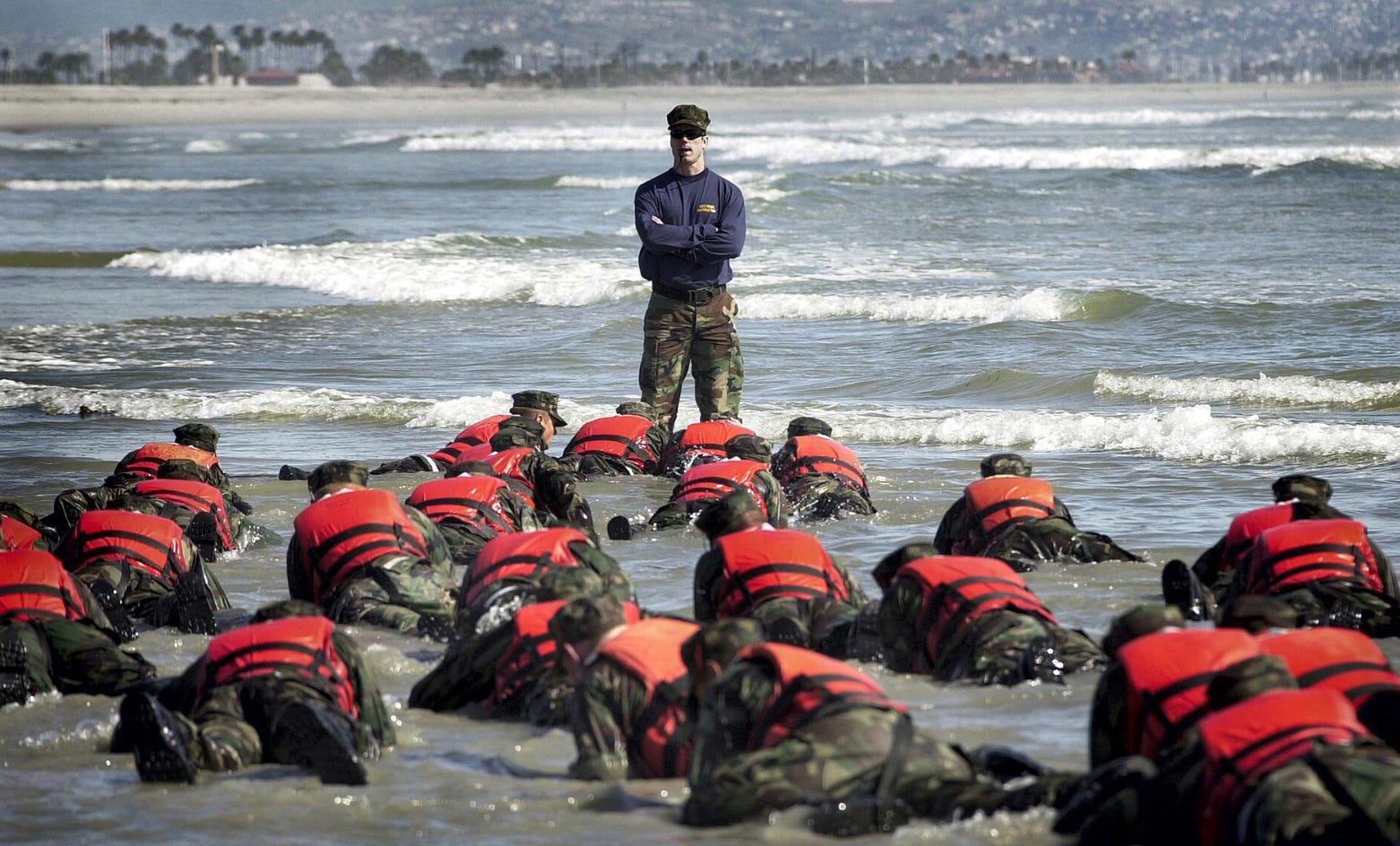
Which of these three things do you think is statistically the most difficult to do in America?
Become a U.S. Navy SEAL.
Get into Harvard University as a freshman.
Be awarded a Chick-fil-A franchise.
If you’ve been with me a while, you might know that the surprising answer is number 3 - the Chick-fil-A franchise.
This is mostly a matter of “fun with statistics,” because CFA gets about 60,000 initial franchise applications per year and only opens between 75 and 80 restaurants. That works out to a .13 percent success rate.
Harvard University? The already self-selecting group of A students, class presidents, and varsity team captains each has about a 3.7 percent shot at getting in.
So let’s talk about the Navy SEALs, which if you count everyone who applies to join the Navy and become one has a 9.5 percent chance of making it through the entire year-plus worth of training.
This includes a single week called Hell Week that has only a 25% to 33% success rate.
Personally, I am happy that there are people who want each of these three things—especially the Navy SEALs—but I don’t think I’ve aspired to be any of them.
However, today is a good day to remember someone for whom becoming a Navy SEAL was an obsession, and who had to try as hard as anyone (over and over) to achieve his goal. Frankly, he’s become quite an inspiration to a lot of other people since.
If you don’t know him already, I invite you to meet David Goggins: retired Navy SEAL (how’s that for foreshadowing?) and author of the out-of-nowhere bestseller, Can’t Hurt Me: Master Your Mind.
Raised in East Buffalo, N.Y., and then a small town called Brazil, Indiana, Goggins describes his childhood as “hell on earth,” including an abusive father and run-ins with the KKK. (Goggins is Black.)
He joined the Air Force after high school, served four years, and then left -- a decision he soon came to regret.
I’ve seen this so many times in writing about people in the military who get out but have no good plan for afterward, and find themselves lost.
Goggins went from one minimum wage job to another, eventually worked as an overnight exterminator, became depressed, eating a box of doughnuts and drinking a big milkshake every morning (among other things), and gained well over 100 pounds.
As he tells it, however, a TV special about Navy SEALs training caught his eye -- one of those reruns you might see in snippets or reruns, over and over -- and gave him a new goal:
I watched men sweat and suffer ... I couldn’t remember feeling as awful as these men looked. They were swollen, chafed, sleep-deprived, and dead on their feet, and I was jealous of them.
The longer I watched the more certain I became that there were answers buried in all that suffering. Answers that I needed.
What Goggins did afterward -- well, it formed the basis for his book, and his career now.
First, had to drop 106 pounds in three months even to enlist in the Navy (after his four years in the Air Force).
Then, he had to repeat Hell Week three times due to injuries.
Finally, after two full years of training, he graduated on August 10, 2001.
Interesting timing, right? Goggins went on to serve another 16 years in the SEALs including combat in Afghanistan and Iraq, complete a bunch of other very challenging military courses, and eventually retired when he hit 20 years combined military experience.
Since then, he’s become known as an ultramarathoner, ultra-distance cyclist, triathlete, and author/speaker. In fact, I don’t think I’d heard of Goggins (I completely missed his book at the time) until a few years ago when readers began citing him as an inspirational and highly quotable role model.
I’m at the point in life when I can’t tell you if 25 years is a lifetime or the blink of an eye, but that’s how long ago yesterday Goggins reached this milestone.
As he put it:
“Our whole life is set up in the path of least resistance. We don’t want to suffer. We don’t want to feel discomfort. So the whole time, we’re living our lives in a very comfortable area. There’s no growth in that.”
Not a bad thing to think about the next time the going gets tough.
Other things worth knowing …
NYT: Top administration officials engaged in an elaborate deception to spirit President Trump out of Turkey during the NATO summit last month, transporting him in a catering container to a military jet because of a threat against him and Air Force One from Iran.
AP: A powerful 7.4 magnitude earthquake struck western Colombia on Monday, killing at least 111 people, damaging hundreds of buildings and leaving many trapped under debris while loved ones and rescue workers searched through rubble.
Axios: President Trump issued an executive order calling for fewer childhood vaccinations, splitting the childhood MMR vaccine into three shots delivered at separate medical visits. Trump suggested the MMR vaccine could be “quite lethal” when administered all at once, and likened the volume to “a bottle of soda.”
AP: Ben Jones, who played the good ol’ boy mechanic in “The Dukes of Hazzard” and parlayed his fame into two terms in the U.S. House, has died at 84. Jones had a heart attack Sunday at his home in Washington, Virginia, as he was waiting to watch his beloved Atlanta Braves play baseball, his wife said on social media.
CNBC: The 10 most in-demand ZIP codes for homebuyers in 2026.
Ars Technica: The first self-driving vehicle on Mars has proven to be a smashing success: about 90 percent of the distance driven by Perseverance has been autonomous.
Wired: How to disable the AI features in Gmail and Google Docs. New AI toolbars and prompts are showing up in Google Docs and Gmail. If you don’t want Gemini’s help writing documents and emails, here’s how to turn that off.
Thanks for reading. See you in the comments.
Great story, one I remember well from the first time.
I do not understand how a former heroin addict, toilet coke sniffing, sewer swimming, road kill eating ______ with all the baggage RFK Jr. has could become the person managing our health care. He has zero medical understanding of vaccines - and especially the mRNA system - with zero scientific or medical training. All you need to do is watch the Dana Bash/CNN interview to see what kind of person he is in this role. And trump believes him enough to sign executive orders that I hope have no legal basis? SMH
If you don’t want a vaccine, fine. Just don’t try to force your opinions on me. And why are you “they” so against masking for health reasons but not for ICE goons?
I feel sorry for all the staff, crew, and journalists that were on the decoy plane. Imagine if it was attacked and some - or all - of those unaware people perished? I wonder what they thought when they learned they were the proverbial bait goats tied to a tree?
Enjoy the Cape and a little relaxation.