

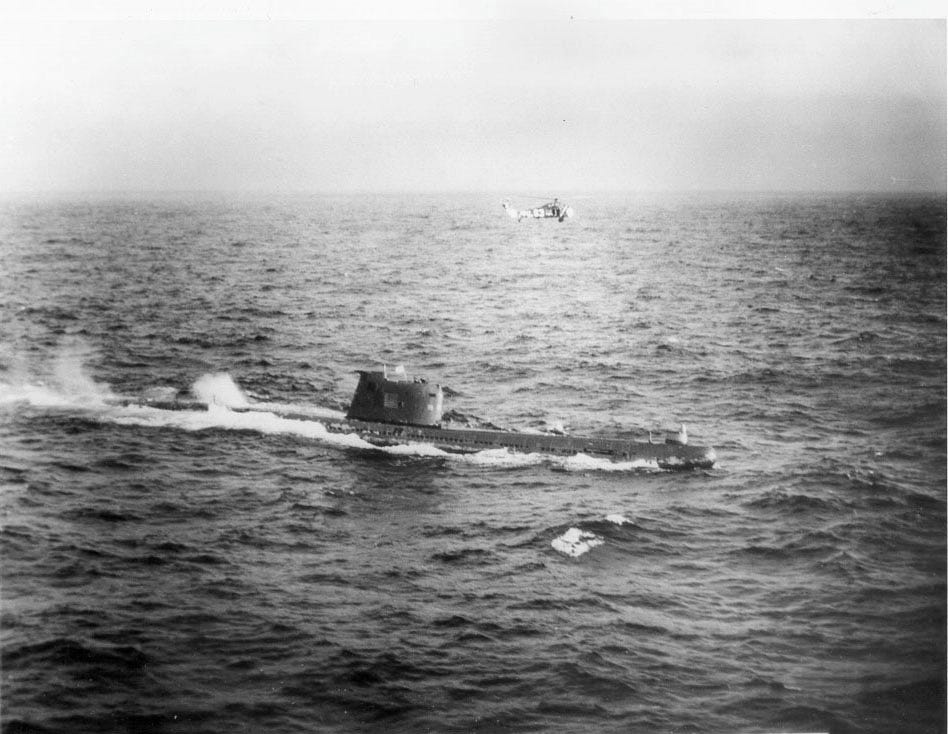
Today’s newsletter is yet another one about how the world nearly ended — or at least, nearly endured a global thermonuclear battle — except for the fact that one man stood athwart history yelling, “wait!”
Then, because of geopolitics and world history and the Cold War, the whole thing remained secret for decades.
Again.
Or actually, I should say — before. I’ve written here in the past about Stanislav Petrov, the Soviet colonel who, in 1983, refused to confirm what appeared to be an American missile attack — against military protocol — because it seemed likely to him he was getting a false warning, rather than seeing an actual attack.
Turns out he wasn’t the only one. Only this one sounds like it was under even more stressful conditions.
Context: the Cuban missile crisis, October 1962.
Four Soviet submarines had left their base in the Kola Bay on October 1, headed for the waters near Cuba. Each carried a nuclear-armed torpedo.
The Americans didn’t know about the nuclear weapons at first, but they did know there were Soviet subs in the area, and they were eventually ordered to find them.
One of those submarines was B-59, commanded by a Soviet captain named Valentin Savitsky. Also aboard was a 36-year-old officer named Vasily Arkhipov, who was chief of staff of the four-submarine brigade.
By October 27, B-59 had been underwater for days, trying to avoid American warships. And things had gotten pretty awful. Conditions:
The temperature in some compartments reached 122 degrees Fahrenheit. Near the engines and sonar equipment, it was even hotter, reaching as much as 149F.
Carbon dioxide levels had climbed to several times the norm. Drinking water was running out, down to about a cup of water per day per sailor.
Equipment was breaking down. Sailors were fainting at their stations, catching their breath, and then going back on watch.
The submarine’s batteries were running low, and the crew couldn’t recharge them without risking detection.
Meanwhile, American destroyers overhead were dropping practice depth charges into the water, trying to force the submarine to the surface. They were meant as a warning.
But when you’re underwater in intense heat with lousy air and someone keeps dropping explosives on you, it’s awfully hard to tell the difference between a warning and an attack.
One officer later compared the experience to sitting inside a metal barrel while somebody kept hitting it with a sledgehammer.
The submarines had been largely cut off from Moscow. What little they knew about the crisis came from fragments of American radio broadcasts, which they didn’t particularly trust.
For all they knew, the war had already started.
Fortunately for everyone — including you and me — Vasily Arkhipov was aboard.
Quick history about Vasily: He’d joined the navy at the end of World War II; technically he served during the Soviet-Japanese War in the last 45 days or so.
Afterward, the Soviets raced and built nuclear submarines to try to keep up with the United States, he was in the thick of it.
He’d already survived one major nuclear emergency not long before: July 1961, he’d been serving as executive officer aboard K-19, the Soviet Union’s first nuclear-powered ballistic missile submarine, when one of its two nuclear reactors lost its coolant.
Seven engineers and an officer managed to improvise an emergency cooling system, preventing a meltdown. But all eight died of radiation sickness within a month, and other crew members died in the years that followed.
Vasily himself was exposed to radiation. And, because this was the Soviet Union, the crew was ordered to keep quiet about the accident.
(That story was dramatized, with some license in the 2002 Harrison Ford movie, K-19: The Widowmaker.)
Now, just 15 months later, Vasily was underwater again, with a nuclear weapon aboard, and American destroyers dropping explosives around him.
According to an account from Vadim Orlov, the officer in charge of B-59’s radio intelligence unit, things came to a head when an especially powerful explosion shook the submarine.
Savitsky, the captain, became furious. Convinced that the Americans were attacking, and apparently believing that war might already have begun, he ordered the officer responsible for the nuclear torpedo to prepare it for launch.
Orlov later recalled Savitsky shouting that they would “die ourselves, sink them all but not stain the navy’s honor!”
Now, combine the chaos of near-war, with the passage of time, and the effort of a Soviet communist bureaucracy to keep its secrets, and a few possible explanations of what happened next emerge.
In one version, the captain wanted to launch the nuclear torpedo — but doing so required the agreement of three senior officers: the captain, the political officer, and Vasily, as chief of staff.
The captain and political officer agreed in this telling, but Vasily refused. No launch.
In another version of the story, the submarine had surfaced, and the captain — alarmed by the American barrage and believing this was a full-scale attack, panicked and ran to order an emergency dive and preparation of the nuclear torpedo.
Only, his path down the ladder was blocked by another officer and his equipment, and during the interlude Vasily could see that the Americans were signaling, rather than attacking.
Because of the delay on the ladder, he was able to stop the order before it reached the torpedo officer.
I should also acknowledge that the one time we know of that Vasily ever described what happened in his own words — a post-Soviet naval conference in 1997 — he downplayed his own role.
He described an American aircraft flying over the submarine, turning on powerful searchlights that blinded the Soviets, and opening fire — but also the moment when he realized the Americans were firing past the submarine as a warning, not trying to sink it.
Vasily, who stayed in the Soviet Navy for decades afterward and reached the rank of vice-admiral, never claimed credit for stopping the launch. He did complain that the story was being used to make the Soviet Navy look bad.
Regardless, the next day, after recharging its batteries, the submarine submerged again and managed to escape the American ships. The crew eventually made it back to the Soviet Union.
The Cuban Missile Crisis ended.
At a meeting afterward, a top Soviet official told the crew of B-59 and its sister boats: “We did not even expect you to come back alive.”
Arkhipov went on to command the Kirov Naval Academy, the Soviet equivalent of the U.S. Naval Academy at Annapolis. He died in 1998, before the full story became widely known.
In 2002, a scholar who studied all this, Thomas Blanton of the National Security Archive, told the Boston Globe that “a guy called Vasili Arkhipov saved the world.”
Fifteen years later, in 2017, Arkhipov’s daughter and grandson accepted the first Future of Life Award on his behalf, honoring his role in preventing a possible nuclear war.
His own family had never heard the story from him.
7 other moments from history this week
Sunday, Oct. 25: “How lucky I was to have a father who, in spite of formidable obstacles, would fight for his beliefs and ambitions and win.” — Benjamin O. Davis Jr., on his father, Benjamin O. Davis Sr., who was promoted to brigadier general on this day in 1940, the first African American general in the U.S. Army. He was 63, after four decades of postings arranged so he would never command white troops.
Monday, Oct. 26: “I tell them my story. I tell them how important these vaccines are.” — Ali Maow Maalin, the Somali hospital cook diagnosed on this day in 1977 with the last naturally occurring case of smallpox. He recovered and spent the rest of his life as a polio vaccinator, telling reluctant parents he had once dodged the smallpox shot because he was afraid it would hurt.
Tuesday, Oct. 27: “Their only purpose was to freeze me out.” — Benjamin O. Davis Jr., on his West Point classmates; he was promoted to brigadier general on this day in 1954, the first Black general in the Air Force. For four years at the academy no cadet spoke to him except on official business, and he went on to command the Tuskegee Airmen.
Wednesday, Oct. 28: “We sell goods cheaper than any house in the world.” — Early Macy’s advertising slogan; Rowland Hussey Macy opened his dry goods store at Sixth Avenue and 14th Street on this day in 1858. First-day sales totaled $11.08.
Thursday, Oct. 29: “Would it not be possible, in time of peace and quiet, to form relief societies for the purpose of having care given to the wounded in wartime by zealous, devoted and thoroughly qualified volunteers?” — Henry Dunant in A Memory of Solferino; the Geneva conference that turned his question into the Red Cross movement concluded on this day in 1863. Dunant shared the first Nobel Peace Prize in 1901.
Friday, Oct. 30: “Shoe rationing will end at midnight tonight, the office of price administration announced today.” — United Press dispatch on this day in 1945, ending the limit that since 1943 had allowed Americans three pairs of leather shoes a year. OPA chief Chester Bowles predicted output would soon match prewar demand of about 30 million pairs a month.
Saturday, Oct. 31: “Man, you owe me absolutely nothing.” — Earl Lloyd, recalling what he told a young NBA player who thanked him; Lloyd became the first Black player in an NBA game on this day in 1950. He had six points and a game-high 10 rebounds for the Washington Capitols in Rochester.
Oh - I see now - Sr. was Army and Jr. Air Force.
Great story today!