

Within months of graduating from Kenyon College in 1980, a young man lost his job and moved back in with his parents.
He’d majored in political science, but his real “thing” was drawing political cartoons for the student newspaper. That led to what looked like a big break: a six-month tryout to do the same thing at the Cincinnati Post.
But it wasn’t a fit. Just guessing here — how much does a 22-year-old know about local politics?
Also, he wasn’t even from Cincinnati to begin with; he’d grown up in the Cleveland suburbs.
Anyway, the tryout was terminated, and our liberal arts hero went home to live with mom and dad. He found his version of career hell: working in the windowless basement of a convenience store, designing ads for car dealerships and grocery stores.
“I hated every single minute of the 4-1/2 million minutes I worked there,” he later recalled. Fortunately for my generation he didn’t turn to drugs to numb the pain — or worse, law school.
Instead, Bill Watterson spent his spare time drawing comics — and submitting them to the syndicates that controlled distribution. Among his ideas:
A strip about a young man his own age finding his first job and apartment.
A strip about animals, and one he called “Spaceman Spiff.”
A strip about a twentysomething named Sam, whose annoying little brother, Marvin, had a stuffed tiger named Hobbes. (Marvin became Calvin later, after another cartoonist launched a strip called Marvin.)
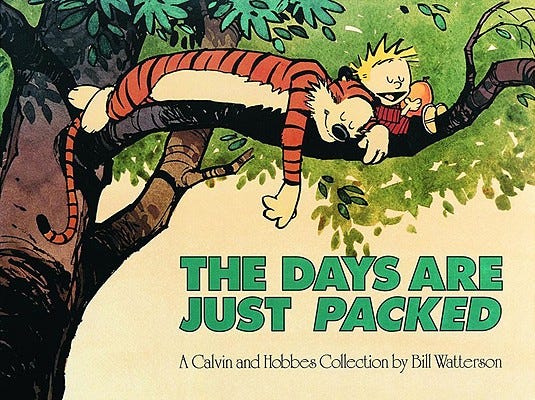
OK, big reveal if you don’t know it already: Watterson was the creator behind the comic strip Calvin and Hobbes, which made its debut 41 years ago this week (November 18, 1985).
For ten years it was the best thing in the newspaper — a six-year-old and his tiger, careening down hills in a wagon while arguing about the meaning of life. It ran from 1985 to 1995, which for most of Gen X covered the stretch from reading the funnies at our parents’ kitchen table to buying our own paper for the first time.
Amazing detail I only just learned after researching this:
A newspaper comics syndicate called United Features had the foresight to tell Watterson to take that strip, ditch the older brother, and flip everything else so that Calvin and his stuffed tiger Hobbes were the main characters.
He was cool with that. But after he spent months refining it, United Features passed — and then came back with a new offer: they’d sign him if he’d add a character to the strip called Robotman.
Why? Better merchandising. He said no":
“Not knowing if Calvin and Hobbes would ever go anywhere, it was difficult to turn down another chance at syndication.
But I really recoiled at the idea of drawing somebody else’s character. It’s cartooning by committee, and I have a moral problem with that. It’s not art then.”
A few more rejections later, Universal Press Syndicate made an offer, and after the debut, the strip spread quickly.
Within a year of syndication, it was running in roughly 250 newspapers. In 1986 Watterson became the youngest person ever to win the Reuben Award for Outstanding Cartoonist of the Year from the National Cartoonists Society, and he won it again in 1988. (He didn’t show up at the ceremony to accept either one.)
Success brought some struggles. Watterson had signed a contract giving his syndicate all exploitation rights to Calvin and Hobbes into the next century, and they wanted to license the characters: toys, T-shirts, a TV show.
Watterson refused — with almost no leverage. In fact, his contract was so one-sided that if he quit, Universal had the right to replace him with hired writers and artists and license the characters anyway.
But he threatened to quit, and Universal decided not to test him. It returned the exploitation rights to him.
The 18 Calvin and Hobbes books have sold nearly 45 million copies, however, so he did fine.
After that battle, Watterson went back and forth in fits of creativity and exhaustion. He took an unprecedented nine-month sabbatical in 1991 — Universal kept charging papers full price for reruns — and came back in February 1992.
Then he worked out a deal to offer the Sunday edition of Calvin and Hobbes only in half-page formats. Many editors, and a few fellow cartoonists, called him arrogant for it.
He took a second sabbatical from April 3 through December 31, 1994. And in November 1995, he sent newspaper editors a letter saying the strip would end with the year.
The final strip ran on Sunday, December 31, 1995. It showed Calvin and Hobbes outside in freshly fallen snow, climbing on a sled, and taking off as Calvin exclaims, “Let’s go exploring!”
Watterson returned to private life in Ohio and has rarely spoken publicly since. In fact, he’s so reclusive that anytime anyone writes about him, they wind up publishing one of the same few old photos that have accompanied articles for 40 years.
Still, as a Gen Xer who became a parent a bit later than most of my peers, I’m happy to say my daughter and I tackled the whole canon of Calvin and Hobbes, starting when she was about six years old.
Generation Alpha, hope you enjoy.
7 other moments from history this week
Sunday, November 15: “The said states hereby severally enter into a firm league of friendship with each other, for their common defence, the security of their Liberties, and their mutual and general welfare.” — Article III of the Articles of Confederation, adopted by the Continental Congress on this day in 1777.
Monday, November 16: “It was strictly a symbolic event, to show that we could do it.” — Cornell astronomer Donald Campbell, on the 1,679-bit radio message that the Arecibo Observatory beamed toward the globular cluster M13 on this day in 1974. M13 is more than 25,000 light-years from Earth, so the message will take at least 25,000 years to arrive.
Tuesday, November 17: “The better we get at getting better, the faster we will get better.” — Douglas Engelbart, who was granted U.S. patent 3,541,541 on this day in 1970 for an “X-Y position indicator for a display system,” the device that became the computer mouse.
Wednesday, November 18: “I don’t know how I did it really. But I did.” — Terry Waite, speaking to the BBC 30 years after his kidnappers in Beirut freed him on this day in 1991, after 1,763 days as a hostage.
Thursday, November 19: “There shall be a firm, inviolable and universal peace, and a true and sincere friendship between His Britannic Majesty, his heirs and successors, and the United States of America.” — Article I of the Jay Treaty, signed in London on this day in 1794.
Friday, November 20: “Avoiding accidents which frequently occur by reason of the over-anxiety of the waiting drivers to start as the signal to proceed is given.” — Garrett Morgan, explaining the purpose of his three-position traffic signal in the patent granted to him on this day in 1923. Morgan, the son of former slaves, later sold the rights to General Electric for $40,000.
Saturday, November 21: “Three encores later, the $25 prize was mine.” — Ella Fitzgerald, recalling Amateur Night at Harlem’s Apollo Theater on this day in 1934, when she was 17. She had planned to dance but switched to singing after learning that a popular dance duo would be the feature act that same night.