

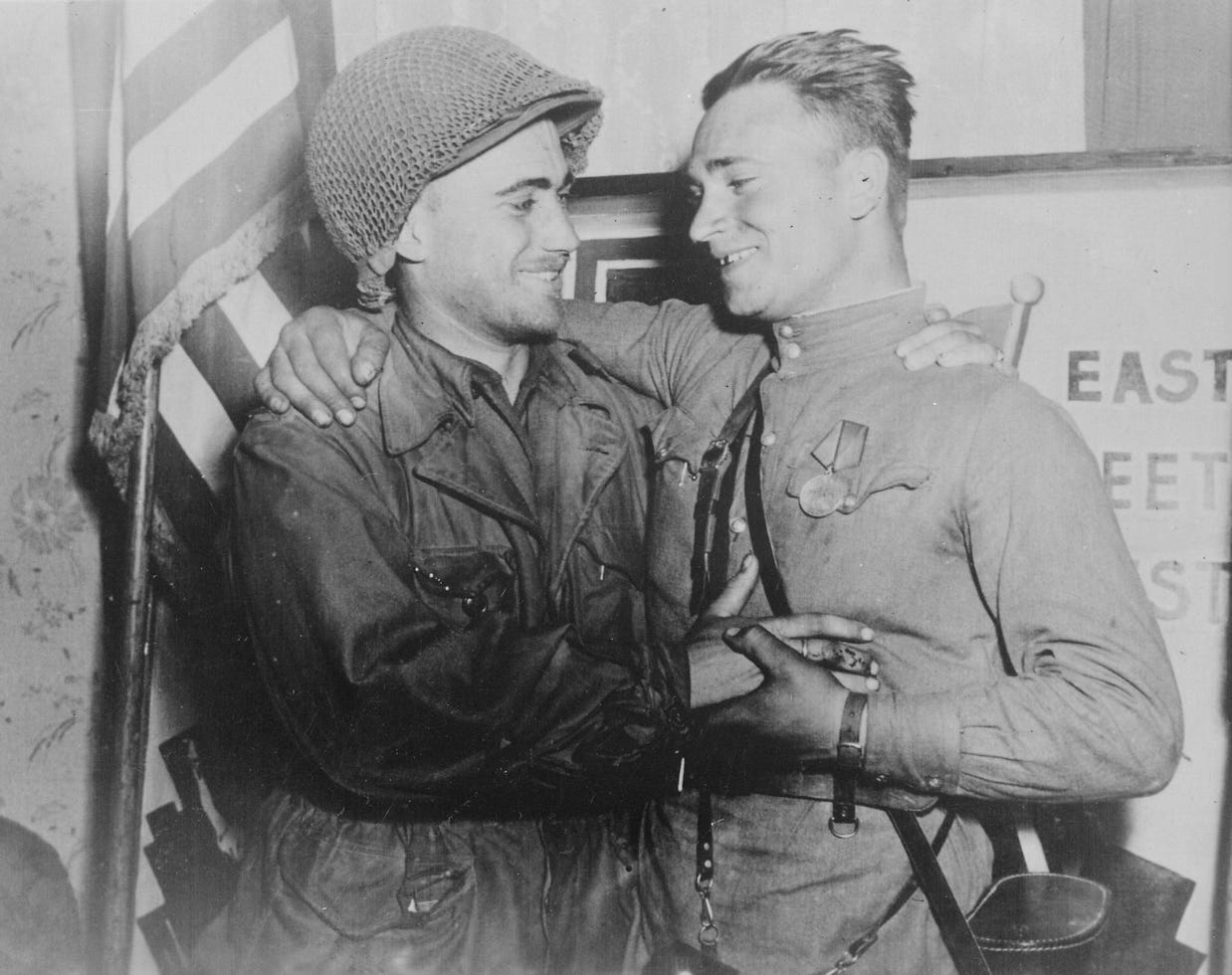
William Dean Robertson was born on January 7, 1924, in Los Angeles, California. He was 21 years old and a second lieutenant in the United States Army on April 25, 1945.
Alexander Silvashko was born in 1923 or 1924 in the Cherkasy region of Ukraine. He was a lieutenant in the Soviet Red Army, fighting westward across the Eastern Front.
Neither man knew the other existed, but 81 years ago this week, they were joined forever in one of history’s most celebrated images, as the Allied armies linked up — one coming from the West, the other from the East — shortly before the surrender of Nazi Germany.
We have something unusual this week: Robertson’s account of what happened that day in his own words. In 1989, someone thought to interview him by telephone and record it. The audio is below, followed by part of the transcript:
There were hordes — hundreds and hundreds of refugees of all description. Released prisoners, escaped prisoners of war, German refugees, slave laborers — with their freedom, coming into the American lines.
I was an intelligence officer for our battalion, and it was my job to make plans for accommodating these refugees. … I went out one day to get a rough idea of how many hundreds were coming into our camp. I took a Jeep with three men and went up and down several roads outside of our town, counting refugees, counting surrendering German troops.
There were two Americans — one was an ensign from the Navy named Peck, and a sergeant. They had been in the OSS and had parachuted behind German lines and been captured. They joined our patrol. So now there were six of us.
We took a bedsheet and fashioned the United States flag. The Russians fired several times, then quit, then fired again. They didn’t believe the flag.
We finally encountered a Russian prisoner of war [and] we instructed him to tell his Russian colleagues on the other side of the Elbe that we were Americans and not Germans. He shouted across. The firing ceased.
I crawled across the girders of the bridge. I met — I think his name was Andreev, a sergeant in Silvashko’s rifle platoon — up on the girders of the bridge.
And then I crawled across to the east bank.
Within a few minutes there were probably 100 or 150 Russians there. We exchanged cap ornaments and wristwatches and mementos. We slapped each other on the back, shook hands. They produced some schnapps and we toasted each other and all our leaders.
And then someone in the Russian lines clearly spoke English, and we made arrangements for our leaders to meet the following day.
I remember it very well.
The following night, the U.S. Army distributed an official photograph of Robertson and Silvashko, arms around each other’s shoulders, grinning.
Robertson came home, went to medical school, completed his residency in neurosurgery at UCLA, raised four sons, and practiced medicine in Los Angeles until his death in 1999.
Silvashko returned to Ukraine to find his family and his village wiped out. He settled in a village in Belarus called Morach, became a schoolteacher and then a school principal.
The two men reunited in Moscow in 1975, then again in what was then East Germany for the 40th anniversary in 1985 — though the Cold War cast a shadow over the celebrations, and official relations between the two countries frequently made the reunions complicated.
Then Silvashko was largely forgotten until 2005, when U.S. Ambassador to Belarus George Krol read a small item in a local newspaper noting that the Soviet soldier in the famous photograph was still alive, and drove hours down dirt roads to find him.
They were not the only ones there that day.
First Lieutenant Albert Kotzebue reached the Soviet lines hours earlier, crossing the Elbe in a rowboat near Strehla and meeting a Soviet soldier on horseback — but there were no photographers.
And there was Joseph Polowsky, a Chicago taxi driver and rifleman on Kotzebue’s patrol, who was so moved by the experience that he spent the rest of his life campaigning for peace.
But Robertson and Silvashko became the symbols — two young men from opposite ends of the world, meeting in the rubble of a defeated country, with nothing in common except the fact that they had both survived long enough to be there.
“Governments can talk,” Robertson said, years later. “But people can do better.”
7 optimistic moments from history this week
April 19: “This will probably be my last long race. Look at my feet — do you blame me for wanting to stop?” — John J. McDermott, a New York club runner who on this day in 1897 won the first Boston Marathon, covering 25 miles from Ashland to Boston in 2 hours, 55 minutes and 10 seconds.
April 20: “We must not forget that when radium was discovered, no one knew that it would prove useful in hospitals. The work was one of pure science. It must be done for itself, for the beauty of science — and then there is always the chance that a scientific discovery may become a benefit for humanity.” — Marie Curie, who on this day in 1902 completed the isolation of one-tenth of a gram of radium chloride from one full ton of pitchblende, after nearly four years of work.
April 21: “All history proves the great path of the world’s commerce to be from East to West.” — Davenport Mayor James Grant, speaking at the grand opening celebration on this day in 1856 of the first railroad bridge across the Mississippi River.
April 22: “It was truly an astonishing grassroots explosion. The objective was to get a nationwide demonstration of concern for the environment so large that it would shake the political establishment out of its lethargy.” — Senator Gaylord Nelson of Wisconsin, the founder of Earth Day, which was first observed on this day in 1970 by an estimated 20 million Americans on 2,000 college campuses and in hundreds of communities.
April 23: “Honi soit qui mal y pense.” — King Edward III of England, which translates as “Shame on him who thinks evil of it” — words the king reportedly spoke on this day in 1348 after picking up a garter that had slipped from a noblewoman’s leg at a court ball, and tying it to his own leg to spare her embarrassment. The phrase became the motto of the Order of the Garter.
April 24: “I cannot live without books.” — Thomas Jefferson, writing to John Adams in 1815 after selling his personal library of 6,487 volumes to Congress to rebuild the collection the British had burned the year before.
April 25: "It has not escaped our notice that the specific pairing we have postulated immediately suggests a possible copying mechanism for the genetic material." — James Watson and Francis Crick, from their 900-word paper published in the journal Nature on this day in 1953, announcing the discovery of the double helix structure of DNA.
Thank you for sharing the story of the two men, it was heartwarming.
I agree, people can do better.
I was a senior in high school and participated in Earth Day at an off-campus event. I remember wearing an armband. Today I live into the spirit of Earth Day by grinding coffee beans that I brew in reusable K-cups.