

Before Ellis Island became a symbol of American promise, immigration to America was handled by individual states through a cramped facility called Castle Garden at Manhattan’s southern tip.
From 1855 to 1890, eight million immigrants squeezed through, without any standardized health inspections or federal oversight. It was clear the system had to change.
The federal government stepped in. President Benjamin Harrison designated a small island in New York Harbor—previously used by the Navy to store gunpowder—as America’s first federal immigration station.
They built a massive three-story wooden structure that would become the gateway through which 12 million people would pass over the next 62 years.
On New Year’s Eve 1891, a steamship called the Nevada sat anchored just off Manhattan. It had arrived too late for its passengers to be processed that day.
Among those passengers were three Irish siblings:
17-year-old Annie Moore and her two younger brothers —
Anthony (15) and
Philip (12).
They’d left Queenstown, County Cork on December 20, spending 12 days at sea—including Christmas—in the cramped conditions of steerage. They were coming to join their parents, who’d emigrated four years earlier and had been living at 32 Monroe Street in Manhattan.
As morning broke on January 1, 1892, bells rang across the harbor. Ships were decorated with red, white, and blue bunting. At 10:30 a.m., a flag on Ellis Island dipped three times—the signal to begin.
A barge ferried the first group of passengers from the Nevada to the dock. When the gangplank lowered, Annie Moore—brown-haired, rosy-cheeked—bounded down with her brothers in tow. She was the first to enter through the enormous double doors.
She climbed the main staircase, skipping two steps at a time, and was directed to one of 10 inspection aisles. An official greeted her, and to mark the historic occasion, presented her with a $10 gold piece. (That coin, according to romantic newspaper accounts, she would “never part with.” The reality was almost certainly different—her father was a longshoreman, and that $10 probably didn’t last the day.)
After passing her health inspection, Annie and her brothers were reunited with their parents. The New York Times headline the next day read: “OPENED BY PRESIDENT HARRISON: Rosy-Cheeked Irish Girl the First New Arrival.”
Her celebrity lasted about 24 hours.
Annie Moore lived out her life in the Lower East Side of Manhattan. She married Joseph Schayer, a bakery clerk who was the son of German immigrants. They had 11 children. Six of them died young. She died of heart failure in 1924 at age 50 and was buried in an unmarked grave in Calvary Cemetery in Queens, alongside six of her children.
For decades, her grave sat unmarked. There was a case of mistaken identity—researchers in the 1990s thought they’d found her in Texas. That woman’s descendants were invited to ceremonies. Irish President Mary Robinson honored her memory.
It was all wrong.
In 2006, genealogist Megan Smolenyak tracked down the real Annie Moore’s great-nephew. The actual story was less glamorous. Annie never left the Lower East Side. She lived in tenement buildings near the Fulton Fish Market. Smolenyak called it “the typical hardscrabble immigrant life.”
In 2008, 84 years after her death, a ceremony was held at Calvary Cemetery. President Obama sent a message of remembrance. A Celtic cross made of Irish blue limestone was finally placed at her grave. Today, bronze statues of Annie Moore and her brothers stand at the quayside in Cobh, Ireland and on Ellis Island itself.
Smolenyak discovered something while researching the family tree. Within two generations, Annie’s descendants had married people from different backgrounds—Irish, German, Italian, Jewish.
“I liked that her family was typically American,” Smolenyak said. “Within just a couple generations, they climbed the socioeconomic ladder and they had married people with all sorts of different backgrounds.”
Forty percent of Americans today are descended from people who passed through Ellis Island. That’s roughly 130 million people who can trace their ancestry through that facility in New York Harbor.
Between 1900 and 1914—the peak years—an average of 1,900 people passed through every single day.
Annie Moore never returned to Ireland. She lived her entire American life within a few miles of where she first stepped off the Nevada. She raised children. She buried six of them. She died at 50.
Ellis Island closed in 1954. The original wooden structure that Annie Moore entered burned down in 1897. In 1990, it reopened as the country’s primary museum on immigration.
For 82 years after her death, nobody could find Annie Moore’s grave. Now there’s a Celtic cross in Calvary Cemetery, because a genealogist wouldn’t let the case go cold.
Every January 1st, there are plenty of things to commemorate. But I like the fact that Annie Moore’s American story—and ultimately, millions of other American stories—all started on the first day of one particular year.
Here’s to the firsts from today we’ll someday celebrate, too.
7 optimistic moments from history this week
Sunday, December 28: "If nobody else is going to invent a dishwashing machine, I'll do it myself!" — Josephine Cochrane, widowed socialite from Shelbyville, Illinois, who received U.S. Patent No. 355,139 for her dishwashing machine on December 28, 1886, after her servants kept chipping her heirloom china and she grew tired of washing the dishes herself.
Monday, December 29: "Meet the young stranger as he enters our city, take him by the hand... and in every way throw around him good influences, so that he may feel that he is not a stranger." — Captain Thomas Valentine Sullivan, retired sea captain and founder of America's first YMCA, which opened in Boston on December 29, 1851, providing a "home away from home" for young sailors on shore leave.
Tuesday, December 30: "The congestion of tramways can be neutralized only by the establishment of high-speed railways — namely, elevated railways or underground railways." — Noritsugu Hayakawa, businessman who brought Tokyo its first subway on December 30, 1927, after visiting London's Underground in 1914 and becoming convinced that Tokyo needed its own underground railway to become a world-class city.
Wednesday, December 31: "From base to dome, the giant structure was alight — a torch to usher in the newborn, a funeral pyre for the old which pierced the very heavens." — The New York Times, describing the first-ever Times Square New Year's Eve celebration on December 31, 1904, when 200,000 people gathered to watch fireworks explode from atop the newspaper's new headquarters, displacing traditional celebrations that had been held at Trinity Church.
Thursday, January 1: "The euro is your money, it is our money. It's our future. It is a piece of Europe in our hands." — Romano Prodi, European Commission President, as euro notes and coins became reality on January 1, 2002, for 300 million Europeans across 12 countries, with fireworks erupting from Berlin to Athens as people queued at ATMs to get the first pristine euros.
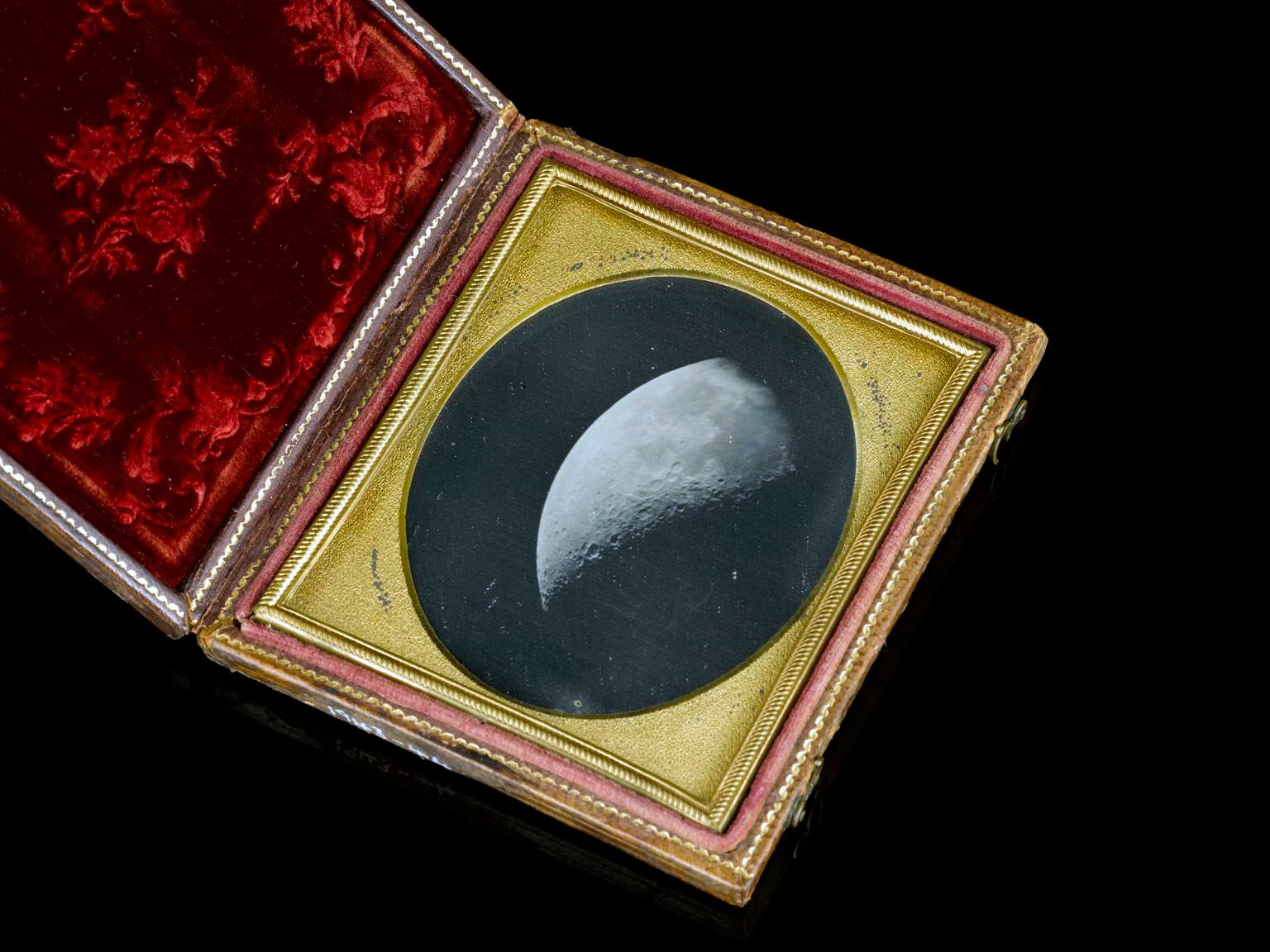
Friday, January 2: “A gift free to the world.” — Louis Daguerre, describing the daguerreotype process when the French government purchased his patent and made it publicly available. On January 2, 1839, Daguerre used his process to capture the first photograph of the Moon, marking the moment astronomers could finally capture celestial images instead of relying on hand-drawn sketches.
Saturday, January 3: "We came looking for carbonates. We have them. We're going to chase them." — Phil Christensen, scientist for NASA's Mars Exploration Rover mission, after Spirit landed on Mars on January 3, 2004 (January 4 UTC), bouncing 28 times before rolling to a stop in Gusev Crater and immediately spotting the first possible sign of water in the distance.
Thanks for reading. Image: John Whipple, William Bond, and George Bond, The Moon, No. 37, 1851, daguerreotype made through Great Refractor Equatorial Mount Telescope, Harvard College Observatory, case size 4-½ x 3-¼ inches. The 1839 version I mentioned above was destroyed in a fire; this is the oldest existing photograph of the moon.
Thanks for the story on the first immigrants in 1892! No ICE back then. Kudos to the persistent genealogist.
Hi Bill - i enjoyed your recent newsletter but I wanted to offer a clarification regarding one sentence that stood out to me: "Within two generations, Annie’s descendants had married people from different backgrounds—Irish, German, Italian, Jewish.”
Judaism is not simply a “background” comparable to national or ethnic origin; it is a faith-based religion with a continuous theological, cultural, and legal tradition. Framing it alongside Irish, German, or Italian implicitly conflates religion with nationality and may unintentionally suggest that the other groups referenced were uniformly Christian. That framing also overlooks the religious diversity present among immigrants to the United States from the very beginning. Immigrants came not only as Christians, but also as Jews, Muslims, Buddhists, atheists and others. As one historical example, Morocco - a predominantly Muslim nation and with a 1000+ year Jewish populace - was in fact the first country to formally recognize the United States. I mention this not as a criticism, but as a point of historical and linguistic accuracy. Language matters, particularly in these turbulent times when discussing identity, faith, and the pluralistic foundations of any nation.
Ramsey