

By the time John Logie Baird was in his 20s, he’d already failed spectacularly at least half a dozen times.
There was the glass razor—rust-resistant but prone to shattering.
The pneumatic shoes stuffed with balloons that burst when you walked.
And, there was the afternoon at university when he tried to create diamonds by heating graphite and shorted out Glasgow’s entire electricity supply.
Born in 1888 in Scotland, Baird suffered from chronic ill health—too sickly for military service in the Great War, too weak to finish his degree. In 1920, broke and unwell, he briefly operated a jam factory in Trinidad before returning to England with another string of failed inventions. Only a thermal sock had sold at all.
But Baird couldn’t let go of something he’d read as a teenager: a German book about the photoelectric properties of selenium.
What if you could transmit pictures through the air, the way radio transmitted sound? By 1923, he’d begun building the world’s first television from whatever he could scrounge: a hatbox, scissors, darning needles, bicycle lenses, a tea chest, sealing wax, cardboard.
(When he accidentally electrocuted himself with 1,000 volts in July 1924, his landlord asked him to leave.)
Baird moved to a cramped attic at 22 Frith Street in Soho and kept working. When he earlier visited the Daily Express to drum up publicity, the news editor was terrified. “For God’s sake, go down to reception and get rid of a lunatic who’s down there,” he reportedly told his staff. “He says he’s got a machine for seeing by wireless! Watch him—he may have a razor on him.”
That began to change in March 1925, when Selfridges department store offered Baird £20 a week for three weeks to demonstrate his device to shoppers.
The images showed only silhouettes, but the public demonstrations generated enough press coverage and scientific curiosity that Baird was no longer dismissed as a lunatic. He’d proven the concept wasn’t fraud.
Baird spent months refining the apparatus. He’d perfected it enough to capture actual gradations of light and shade—the first person televised was William Edward Taynton, a 20-year-old office worker who happened to be nearby. But nobody was around to see it.
By 1926, he felt ready to show scientists what he’d accomplished. He invited members of the Royal Institution to witness his television on the evening of January 26—100 years ago today. Forty scientists in evening dress climbed the stairs to Baird’s laboratory to see what he now called television.
The equipment filled the cramped room. Baird demonstrated with Stooky Bill, then with a human face. Images measured just 3.5 by 2 inches.
A Times reporter wrote that they were “faint and often blurred, but substantiated a claim that through the ‘Televisor’... it is possible to transmit and reproduce instantly the details of movement, and such things as the play of expression on the face.”
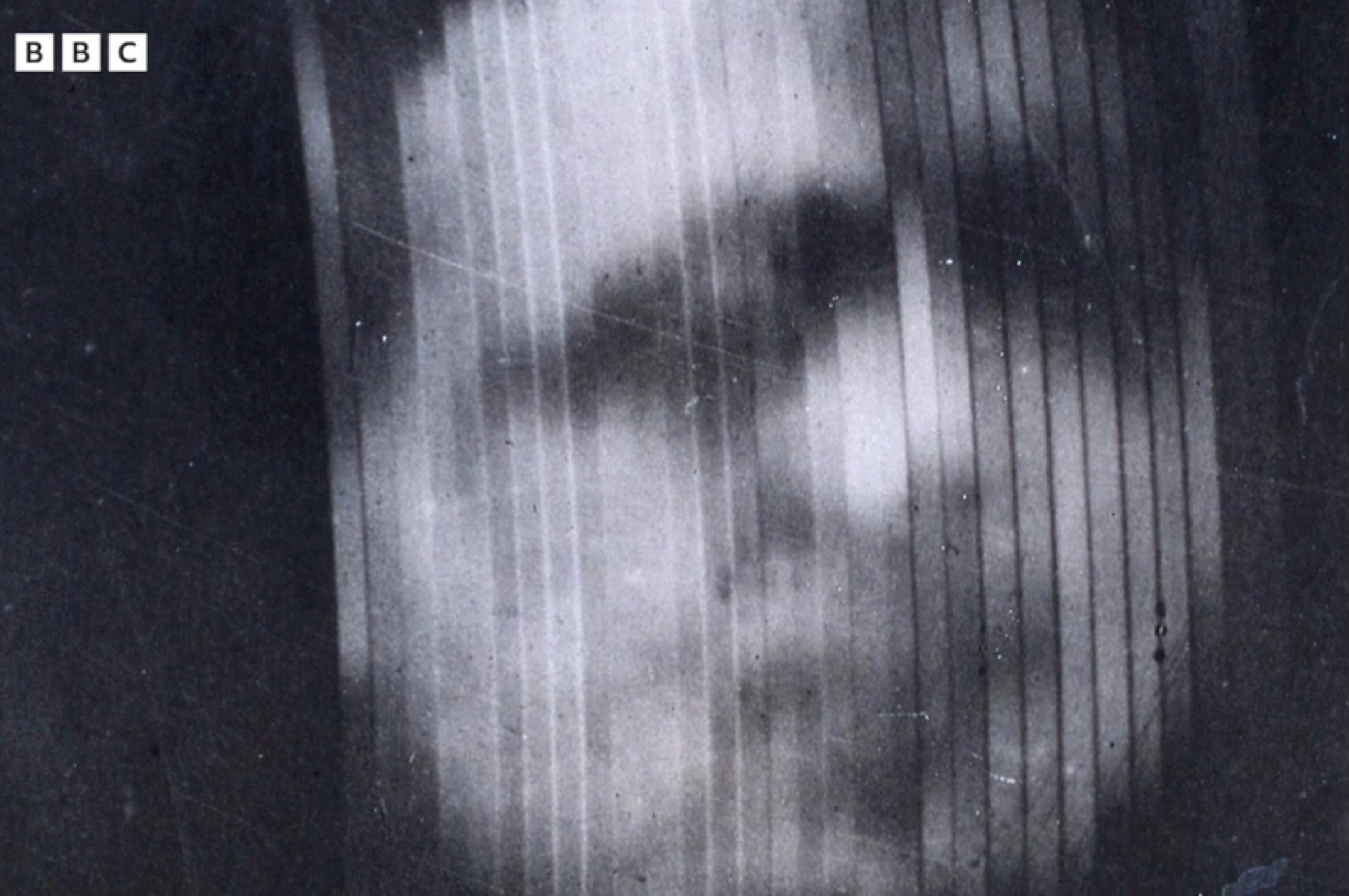
That lukewarm assessment, buried two days later, was the only published response. None of the distinguished scientists wrote anything about what they’d witnessed. They had stood in that attic watching the future flicker on a tiny screen and hadn’t recognized it. When a businessman visited in April, hoping to invest, he concluded that putting the device on the market would be “an error of judgment.”
Within months, however, reports from other dignitaries grew more positive. By 1927, Baird transmitted television over 438 miles from London to Glasgow. In 1928, he sent it across the Atlantic. The BBC began experimental broadcasts using his system in 1929.
His mechanical system would eventually be superseded by electronic television. By 1937, the BBC adopted a superior system from Marconi-EMI. A fire destroyed Baird’s laboratories that year. He died in 1946 at age 58, nearly forgotten, after suffering a stroke.
But on that Tuesday evening in Soho, television had crossed from dream to reality. The scientists who climbed those stairs had no way of knowing they were witnessing one of the pivotal moments in human communication. They saw blurred images on a tiny screen, cobbled together by a man who’d failed at nearly everything he’d tried. They looked at the future and saw an error of judgment.
Historians would later mark that evening as the watershed when television became real—not because the technology was perfect, but because someone had proven it could exist at all.
7 optimistic moments from history this week
Sunday, January 25: "I took off my cap and wanted to yell with the crowd, not because I had gone around the world in 72 days, but because I was home again."—Nellie Bly, who completed her record-breaking trip around the world in 72 days, 6 hours, and 11 minutes, this day in 1890. She set out to beat the fictional Phileas Fogg's 80-day journey from Jules Verne's novel, traveling alone with just one small handbag.
Monday, January 26: "I was so sick crossing the ocean that I kept praying the ship would sink. I wasn't even nervous the day of the race. Why would I be? I knew I couldn't win."—Charlie Jewtraw, who won the first Gold Medal in Winter Olympics history in the 500-meter speed skating event, this day in 1924.
Tuesday, January 27: "I have not failed. I have succeeded in proving that those 10,000 ways will not work. When I have eliminated the ways that will not work, I will find the way that will work."—Thomas Edison, who on this day in 1880 received Patent No. 223,898 for his incandescent electric lamp, paving the way for universal domestic use of electric light.
Wednesday, January 28: "Check your egos at the door."—Sign posted by producer Quincy Jones at A&M Studios, where 46 music superstars gathered after the American Music Awards to record "We Are the World" for African famine relief, this day in 1985. The song raised over $63 million for humanitarian aid and sold more than 20 million copies worldwide.
Thursday, January 29: "The operation of mainly light carriages for the conveyance of one to four passengers."—Karl Benz's patent application for the Benz Patent-Motorwagen, submitted this day in 1886. Patent No. 37435 is considered the birth certificate of the automobile.
Friday, January 30: "I'd like to say thank you on behalf of the group and ourselves, and I hope we've passed the audition."—John Lennon's final words at the end of The Beatles' unannounced 42-minute rooftop concert at 3 Savile Row in London, this day in 1969.
Saturday, January 31: “They had seen the future, and it works, at least as far as their digestive tract.”—A news reporter observing Russian customers lining up to pay the equivalent of several days’ wages for Big Macs at the Soviet Union’s first McDonald’s, which opened in Moscow this day in 1990. (Of course, it was closed after the Russian invasion of Ukraine in 2022.
Yet another one I’d had no knowledge of at all. Thanks Bill!
It’s amazing how far technology has come in 100 years.