

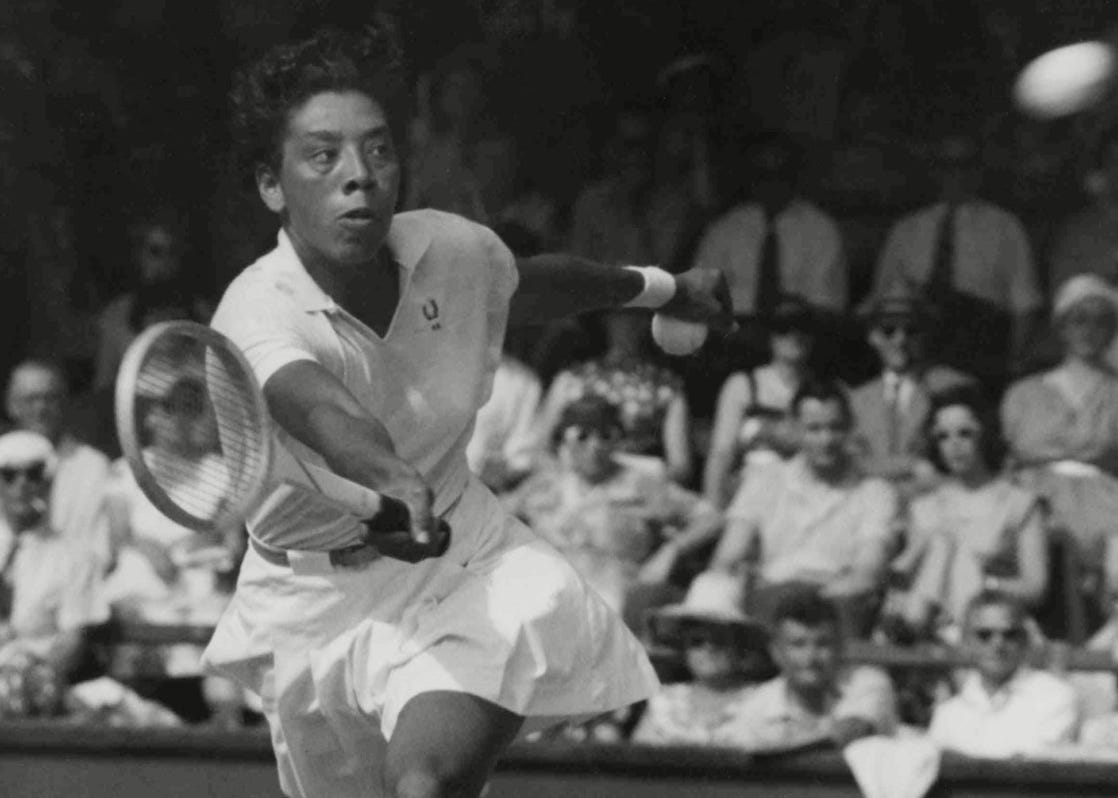
Let’s talk about Althea Gibson.
Sometimes I tend to hide the name of the person we’re talking about, because as soon as you see the name you’ll know the story. But honestly, I wonder how many people today will know who she was, or why we’re writing about her?
Althea Gibson was born August 25, 1927, on a sharecropper’s farm in Silver, South Carolina.
Three years old when her family joined the Great Migration north, settling in Harlem at the start of the Depression. She skipped school constantly, dropped out at 13, and was, by most accounts, heading in the wrong direction.
What saved her: a paddle tennis court on 143rd Street, set up by the Police Athletic League to keep troubled kids off the streets. Althea was immediately, obviously, preternaturally good.
A musician and PAL coach named Buddy Walker noticed her, bought her a secondhand racket, and brought her to the Cosmopolitan Club in Harlem, where members pooled money to give her a junior membership and lessons from the club professional.
She won her first junior ATA title at 15. She won it again at 16.
For the next seven years she was the top-ranked player on the African American tennis circuit — which existed because the U.S. Lawn Tennis Association ran its events at whites-only clubs and excluded Black players from competition.
Sugar Ray Robinson and his wife befriended her and introduced her to two Black physicians who had made it their project to develop Black tennis players: Dr. Hubert Eaton of Wilmington, North Carolina, and Dr. Robert Johnson of Lynchburg, Virginia. Each took her into their home, coached her, insisted she finish high school. She did, graduating at 22, then won a scholarship to Florida A&M, graduating in 1953.
But the USLTA remained closed to her. Tournament players were required to qualify through sanctioned events held at clubs where Black people were not permitted.
In 1950, Alice Marble — a four-time U.S. champion — wrote an editorial in American Lawn Tennis magazine calling the tennis establishment “unwilling to give an opportunity to a potential champion simply because of race.”
She said she was ashamed of her sport. The USLTA relented.
In August 1950, Althea became the first Black player to compete at the U.S. Nationals at Forest Hills, losing narrowly in the second round to the reigning Wimbledon champion.
A journalist wrote: “In many ways, it is even a tougher personal Jim Crow-busting assignment than was Jackie Robinson’s when he first stepped out of the Brooklyn Dodgers dugout.”
She struggled for the next several years — inconsistent, fading, by 1955 considering quitting entirely and joining the Army. Instead, the State Department recruited her for a goodwill tennis tour of Southeast Asia.
She came back transformed.
In 1956 she won the French Open.
In 1957, 69 years ago today, she walked onto Centre Court at Wimbledon as the top seed — the first Wimbledon final attended by Queen Elizabeth II as monarch — and defeated Darlene Hard 6-3, 6-2 in under an hour.
When the Queen handed her the trophy, Althea wept and said: “At last. At last.”
New York gave her a ticker tape parade — only the second Black American so honored, after Jesse Owens. She won Wimbledon again in 1958, and the U.S. Nationals again. The Associated Press named her Female Athlete of the Year both years.
Then she retired — not by choice.
Amateur tennis offered no prize money, and she was broke.
“The truth, to put it bluntly,” she wrote, “is that tennis doesn’t pay enough for me to eat.”
She played exhibition matches before Harlem Globetrotter games, recorded a jazz album, appeared on The Ed Sullivan Show, landed a small role in a John Wayne film.
In the 1960s she became the first Black woman on the LPGA professional golf tour.
Thirty years later, she suffered strokes and debilitating health problems; in 2001 her former doubles partner Angela Buxton received a phone call: Althea was broke, sick, unable to pay her rent or medical bills, and talking about ending her life.
Buxton — one of Althea’s few close friends on tour, both of them marginalized, one for being Black, one for being Jewish — launched a public fundraising campaign.
Think of it as a GoFundMe before there was GoFundMe. The tennis world raised nearly $1 million. It was enough to get Althea through her final years.
She died in September 2003, at 76.
Billie Jean King said: “If it hadn’t been for her, it wouldn’t have been so easy for Arthur, or the ones who followed.”
Before Serena Williams won her first Grand Slam in 1999, she’d faxed Althea a letter asking for advice. Althea wrote back. What they said to each other was never made public.
But I hope this newsletter lets a few more people remember Althea Gibson.
7 other moments to know from history this week
July 5: “This Fourth of July is yours, not mine. You may rejoice, I must mourn.” — Frederick Douglass, from the speech he delivered on this day in 1852 at Corinthian Hall in Rochester, New York, to the Rochester Ladies’ Anti-Slavery Society — an Independence Day address that has since been called one of the greatest speeches in American history.
July 6: “I remember coming into the fete and seeing all the sideshows. And also hearing all this great music wafting in from this little Tannoy system. It was John and the band. I just thought, ‘Well, he looks good, he’s singing well and he seems like a great lead singer to me.’” — Paul McCartney, recalling the afternoon of this day in 1957, when he arrived by bicycle at the garden fete of St. Peter’s Church in Woolton, Liverpool, and first heard a 16-year-old named John Lennon performing with his skiffle group, the Quarrymen.
July 7: “Dear Mr. Andropov, my name is Samantha Smith. I am ten years old... I have been worrying about Russia and the United States getting into a nuclear war. Are you going to vote to have a war or not?” — Samantha Smith, in the letter she wrote to Soviet General Secretary Yuri Andropov in November 1982. Andropov wrote back personally and invited her to visit the USSR. On this day in 1983, Samantha and her parents flew to Moscow.
July 8: “Proclaim LIBERTY throughout all the Land unto all the inhabitants thereof.” — The inscription on the Liberty Bell, rung on this day in 1776 to summon the citizens of Philadelphia to the State House yard — now Independence Square — where Colonel John Nixon read the Declaration of Independence aloud for the first time to a public audience.
July 9: “Remember your humanity, and forget the rest.” — Bertrand Russell, from the Russell-Einstein Manifesto, released at a press conference in London on this day in 1955. The document was co-written by Russell and Albert Einstein — whose signature was his final public act before his death three months earlier — and signed by nine other leading scientists and Nobel laureates, warning that a war fought with hydrogen bombs could end the human race.
July 10: “To be given the opportunity to make the last kick to win a World Cup is an unspeakable emotion.” — Brandi Chastain, who on this day in 1999 scored the decisive penalty in the shootout that gave the United States its second Women’s World Cup title, defeating China 5-4 at the Rose Bowl in Pasadena before a crowd of 90,185 — the largest audience ever to attend a women’s sporting event.
July 11: “You have one year off from your job to write whatever you please. Merry Christmas.” — Note accompanying the gift of a year’s salary given to Harper Lee at Christmas 1956 by her friends Michael and Joy Brown, who wanted her to have time to write. The result: To Kill a Mockingbird, published on this day in 1960, which won the Pulitzer Prize and has sold more than 40 million copies.
What blows me away, and I’m not sure I knew this about Ms Gibson was that she played golf at such a high level. I’ve known several women though who were great golfers who started out as tennis players. The swing technique is similar just on a different plane so it makes sense.
She succeeded in every way that society demands. She turned her life around, she was a very successful athlete and went on to get a college degree. That she was treated so abysmally, again, says so much more about the white culture she and so many other like her have had to fight against all their lives than anything that could ever be said about her.
Some years ago, I worked with an African-American CNA named Althea. I was curious about her name and looked it up to find the meaning and learned that it could mean strength and resilience, and even warrior according to one source. When I saw her the next day, I told her what I had learned, adding that there was a famous tennis star named Althea Gibson. Her face lit up and she said “That’s who I was named for!” This is the only reason I knew about that tennis star. So I was delighted to read her full story today in your column. Thank you, Bill!