

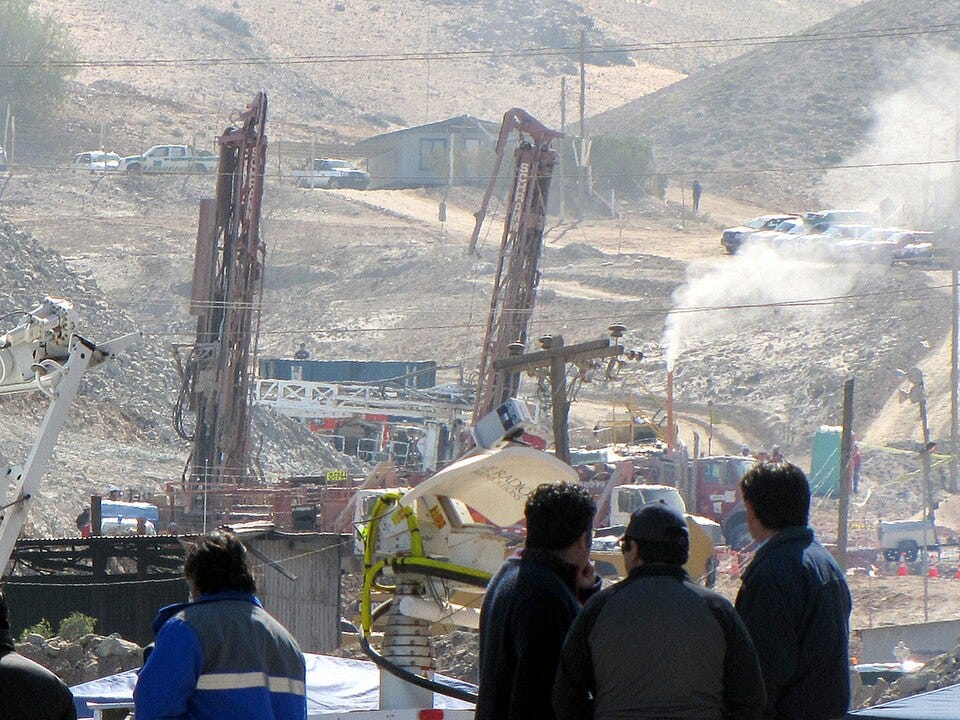

This is a story about a man named Brandon Fisher, who ran a small manufacturing business in Pennsylvania and wound up saving 33 people half a world away.
At around 2 p.m. on August 5, 2010 — sixteen years ago this week — roughly 700,000 tons of rock collapsed inside the San Jose copper and gold mine in Chile’s Atacama Desert, sealing off the only way in or out.
Thirty-three miners were trapped nearly half a mile down. A second collapse two days later blocked the ventilation shafts that might have doubled as an escape route.
For seventeen days, nobody on the surface knew if any of the men were still alive.
Fisher had faced a version of this problem before — and much closer to home.
He was the founder of Center Rock Inc., a drill-bit manufacturer in Berlin, Pennsylvania, with about 75 employees. In 2002, nine coal miners had become trapped in the flooded Quecreek Mine, in the same corner of Somerset County as Center Rock’s headquarters, and it was Fisher and his company who built the custom bit that carved the rescue shaft. All nine men came out alive.
It was the kind of job almost nobody else in the industry had ever had reason to practice. And it was exactly why, soon after the Chilean disaster, a drill distributor who carried Center Rock’s equipment thought to put Fisher in touch with the Chilean government.
Fisher designed a rescue plan that became known as Plan B — one of three separate drilling efforts racing to reach the trapped men by three different routes, on the theory that at least one had to work.
His employees back in Berlin worked around the clock manufacturing the equipment he’d need. Fisher flew to Chile.
The work was closer to surgery than drilling. Rescuers had located the miners’ refuge with a narrow, five-inch borehole; Fisher’s job was to widen that same hole, following it down through 2,000 feet of hard, fractured rock and old, unmapped mine workings, at an angle just off vertical.
Plan B broke through in early October. On October 13, 2010 — 69 days after the collapse — the first miner rode a steel capsule called the Fénix to the surface, and over the next twenty-two hours, all 33 came up alive.
Four months later, Fisher was a guest at President Obama’s 2011 State of the Union address. Obama told the country what had happened in Chile, then added this:
Working three or four days at a time without any sleep. Thirty-seven days later, Plan B succeeded, and the miners were rescued.
But because he didn’t want all of the attention, Brandon wasn’t there when the miners emerged. He’d already gone back home, back to work on his next project.
One of his employees said of the rescue, “We proved that Center Rock is a little company, but we do big things.”
We do big things.
Fisher was 26 when he started Center Rock in 1998 — just four years before Quecreek. In his part of the country, as he put it, “everyone in our community was either a miner or a farmer.”
If his career had unfolded even slightly differently, 33 people in another country might never have had the chance to survive.
7 other moments from history this week
Sunday, August 2: The Tower Subway, the world’s first underground tube railway, opened this day in 1870, carrying passengers beneath the Thames in a cable-hauled carriage. “It is not advisable to attempt the passage in high-heeled boots,” wrote Charles Dickens Jr., son of the novelist, describing the cramped tunnel in an 1879 London guidebook.
Monday, August 3: Mary Lou Retton, 16 and competing weeks after knee surgery, scored consecutive 10s on vault to become the first American woman to win Olympic all-around gymnastics gold. “I knew from the takeoff, I knew from the run — I just knew it,” she recalled to the Los Angeles Times a decade later.
Tuesday, August 4: A jury acquitted printer John Peter Zenger of seditious libel in minutes, a verdict later credited as a founding moment for freedom of the press in America. “It is not the cause of one poor printer, but the cause of liberty,” his lawyer, Andrew Hamilton, told the jury in his closing argument.
Wednesday, August 5: Cyrus Field’s transatlantic telegraph cable briefly connected North America and Europe by wire, cutting communication time from ten days to minutes before it failed weeks later. “Newspapers vie with each other in gas and grandiloquence,” wrote George Templeton Strong, a New York diarist, describing the public celebration once the cable went live.
Thursday, August 6: Gertrude Ederle, 20, became the first woman to swim the English Channel, beating the existing men’s record by nearly two hours. “I knew it could be done, it had to be done, and I did it,” she told The New York Times after finishing her swim.
Friday, August 7: George Washington established the Badge of Military Merit, the first military honor created for common soldiers rather than officers, and the direct ancestor of today’s Purple Heart. “The road to glory in a patriot army and a free country is open to all,” he wrote in the general order that created it.
Saturday, August 8: Wilbur Wright’s brief public flight at Le Mans silenced years of European skepticism that the Wright brothers had ever flown at all. “Gentlemen, I’m going to fly,” he said quietly, turning his cap backward before taking off.
Hey Bill,
Love your work!
In these Big Optimism anniversary posts, can you please include the year of the events?
Really helps putting it into context. 🌞
It’s nice to be reading about regular people doing big things in service of others. It’s getting tiring reading about high profile people doing big things but only for themselves or, even worse, doing big things that will have negative impacts on humans and the planet.
I remember the Atacama mine rescue and how so many were positively impacted by the hard work of everyone but especially the US company that made it all possible.