

Hey everyone. Do me a favor. Every evening, the first person who looks over Understandably and Big Optimism is my friend Tom Bennett in Maine.
I can’t begin to tell you how many times he’s caught mistakes, saved my bacon, and made really good suggestions.
Sunday was Tom’s birthday. He’s the real unsung hero of this effort. So if you have a minute, please wish him well in the comments.
I’ll go first. Happy birthday Tom! You rock, brother!
‘What would change in Oklahoma’
Today’s story is about a piece of American history I never knew or understood until a Life Story Magic customer explained it to me. As soon as he did, I realized it would be my entry in the Big Optimism series this week.
It starts for our purposes on November 16, 1907, when Oklahoma became a state. Within weeks, the new state legislature passed Senate Bill One, mandating racial segregation on public transportation.
The state constitution already required separate schools for “white and colored children.” Similar laws followed: a strict ban on interracial marriage and, in 1910, a “grandfather clause” requiring people whose ancestors had not been eligible to vote in 1866 to pass a literacy test before voting.
Born into this version of Oklahoma in 1923 was Clara Mae Shepard, who was Black and whose father, Ezell, was a wounded World War I veteran who came home to work as a bricklayer. Her mother, Isabell, ultimately shared her deepest, most troubling memory with her daughter.
This quote from Clara in an interview many years later sets the stage for her early life as well as anything I could dream up:
I was born in a segregated area. I went to a segregated school. ...
I have had the experience of going to the back of the bus, not being able to go to libraries, public accommodations and what have you. I’ve always hated segregation with a passion. ...
My mother was from Texas and she saw a black person burned in Paris, Texas and she was afraid that would happen to anyone who spoke out against segregation.
When I would say, ‘Why do we have to go to the back of the bus?’ my mother would say, ‘Shut up’; my dad would say, ‘Someday you’ll be able to ride anywhere on the bus.’
He had a lot of faith in what would happen and what would change in Oklahoma.
There was another formative experience: When her brother got sick, the local whites-only hospital refused to treat him.
Clara grew up, graduated from Langston University in 1944 and became the first Black student admitted to the graduate history program at the University of Oklahoma, where she earned a master’s degree in 1951.
She married, had children, became a teacher at a segregated Oklahoma City-area high school and served as adviser to the Oklahoma City NAACP Youth Council.
Each year, she wrote plays for her students to perform during what was then called Negro History Week. Her 1957 play, Brother President, about Martin Luther King Jr., attracted enough attention that she was invited to take a group of her students to New York City to perform it the following year.
That trip—and the students’ experience of being served at the same restaurants as white people for the first time—led to a chain of events.
On August 19, 1958—68 years ago this week—Clara Shepard Luper led 13 of her students to the segregated lunch counter at Katz Drug Store in Oklahoma City, where they ordered 13 Cokes, endured vitriol and worse, and kept returning for three full days until the chain agreed to end segregation—not only in Oklahoma City, but at all 38 of its locations.
It was Clara’s young daughter Marilyn who came up with the idea. Clara trained the children in tactics of nonviolence beforehand and reached out to the people who ran the drugstore, to no avail.
This was nearly 18 months before the Greensboro sit-ins, which I’ve written about here before.
Clara led many more similar protests at other restaurants, cafeterias, theaters and hotels over the next six years.
She marched in Selma, was beaten by a state trooper and was arrested 26 times. By one account, the strain of her activism eventually ended her marriage.
Clara Shepard Luper died in 2011. Last year, the Clara Luper National Sit-In Plaza was dedicated on the former Katz Drug Store site in Oklahoma City, at the corner of Robinson and Main.
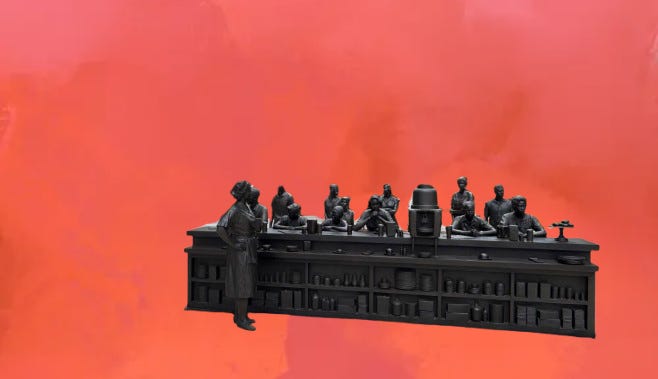
The $3.6 million bronze monument depicts Luper and her students at a lunch counter, with one open stool for visitors to sit on.
Honestly, let me confess my historical ignorance: If I had ever heard of the earlier Oklahoma City movement, I’d forgotten it.
But we all know it now.
Next week, if all goes well, I’ll tell the Life Story Magic story of how I learned it.
7 other moments from history this week
Sunday, August 16: “I am just happy I won. 9.58 seconds is definitely a big thing. I am proud of myself because I’m the first man to do that.” — Usain Bolt, after breaking his own 100-meter world record at the World Championships in Berlin on this day in 2009, running 9.58 seconds, a jump statisticians called decades ahead of the event’s usual pace of improvement.
Monday, August 17: "I had a light breeze against me the whole way ..." — Robert Fulton, writing about his North River Steamboat's round trip from New York City to Albany on this day in 1807, proving steam power could beat wind and current on a commercial route, not just in a demonstration.
Tuesday, August 18: "It marked the end of this particular stage of my struggle to break the system of 'White Supremacy.'" — James Meredith, on this day in 1963, when he became the first Black student to graduate from the University of Mississippi.
Wednesday, August 19: “A gift free to the world” — how the French government described Louis Daguerre’s new photographic process when it publicly unveiled the daguerreotype to the French Academy of Sciences on this day in 1839.
Thursday, August 20: “So far, we have only good news from the front. The official ceasefire … is holding.” — Col. Yrjo Helanen, the Finnish UN observer a UN-brokered ceasefire took effect ending the eight-year Iran-Iraq War in 1988.
Friday, August 21: “It’s a visceral reaction. You feel something in the pit of your stomach like something is wrong in the day, something is not right.” — Fred Espenak, retired NASA astrophysicist, describing totality during the “Great American Eclipse” on this day in 2017, the first total solar eclipse to cross the entire continental United States coast-to-coast since 1918.
Saturday, August 22: "Your Majesty, there is no second." — reply given to Queen Victoria, watching from the Royal Yacht as the schooner America won the £100 Cup around the Isle of Wight on this day in 1851, so far ahead of the British fleet that no other boat was in sight when she finished. The trophy was later renamed the America's Cup.
Happy Birthday, Tom!
Happy belated birthday, Tom! You share a birthday with my oldest son. He’s great and I’m sure you are too!