

The first photocopy in history was a smudge of powder on a sheet of wax paper, and it read like this:
10-22-38 ASTORIA.
That was 88 years ago this week, as you might have been able to figure by yourself, and it was created in a rented room behind a beauty salon in Queens.
The man who made it was a 32-year-old patent manager named Chester Carlson. It would take another 21 years before an ordinary office worker could press a button and get a copy of anything.
Carlson had a lot of practice waiting.
Born in Seattle in 1906, the only child of an itinerant barber, his father had tuberculosis and later arthritis of the spine, and by age 14 Chester was working after school and on weekends for a local printer to support the family.
His mother died of tuberculosis when he was 17. He worked his way through junior college, then Caltech, and graduated with a physics degree in 1930.
Perfect timing, if your goal was to enter the job market at the start of the Great Depression. He applied to 82 companies. Two wrote back, and neither offered him anything.
Eventually he landed a low-paying job at Bell Labs in New York, got bored, and transferred to the patent department. A few years later he was running the patent department at an electronics firm called P.R. Mallory.
This is where he met his nemesis: copies.
Every patent filing needed copies of the specifications and drawings, and there were never enough carbons. If you needed more copies, somebody retyped the whole thing and proofread it all over again.
It got personal at night. Carlson started law school in 1936, and to save money he copied passages by hand from borrowed textbooks. Meanwhile, he’d developed the same spinal arthritis as his father, so all that copying hurt.
He decided to invent a machine that would do it for him.
He started in his kitchen in Queens, melting sulfur onto zinc plates on the stove.
Some of the experiments caught fire, and the apartment was smoky and smelly enough that his wife eventually laid down the law. The lab moved to the back of a beauty salon in Astoria owned by his mother-in-law.
(He’d already filed for a patent in 1937, before he had a process that actually worked. That’s the kind of confidence you develop when you spend all day in a patent department.)
In the fall of 1938 Carson hired Otto Kornei, a young physicist who’d fled Germany.
On October 22, Kornei wrote the date and place in India ink on a glass microscope slide. They charged a sulfur-coated plate by rubbing it with a handkerchief, laid the slide on top, and held it under a bright lamp for a few seconds. Then they dusted the plate with powder, blew off the excess, and pressed it onto wax paper.
There it was. Fuzzy, but there.
Now came the easy part: selling it.
Kidding.
Between 1939 and 1944, Carlson pitched more than 20 companies, including IBM, Kodak, General Electric and RCA, plus the Army Signal Corps. Every one of them said no. Even the National Inventors Council said no.
The strain cost him. The arthritis got worse, the money worries piled up, and his marriage ended.
His big break came almost by accident in 1944.
An engineer named Russell Dayton from the Battelle Memorial Institute, a nonprofit research outfit in Columbus, Ohio, visited Mallory’s patent department and got to talking with Carlson. Before long, Battelle signed on to develop the process, swapping in a selenium-coated plate and better dry ink.
A few years after that, a small photographic-paper company in Rochester called Haloid licensed the technology. Haloid’s executives thought “electrophotography” was a mouthful, so they asked a classics professor at Ohio State for something better.
He came up with “xerography,” from the Greek for “dry writing.”
Haloid announced the process to the public on October 22, 1948, ten years to the day after the Astoria slide.
But the early machines were fussy, complicated contraptions. It wasn’t until September 1959 that the company unveiled the Xerox 914, the first automatic plain-paper copier: paper on the glass, push a button, done.
(The 914 was named for the largest page it could copy, 9 by 14 inches. Not every name requires a classics professor.)
Two years after the 914 hit the market, Haloid had renamed itself Xerox and broken into the Fortune 500.
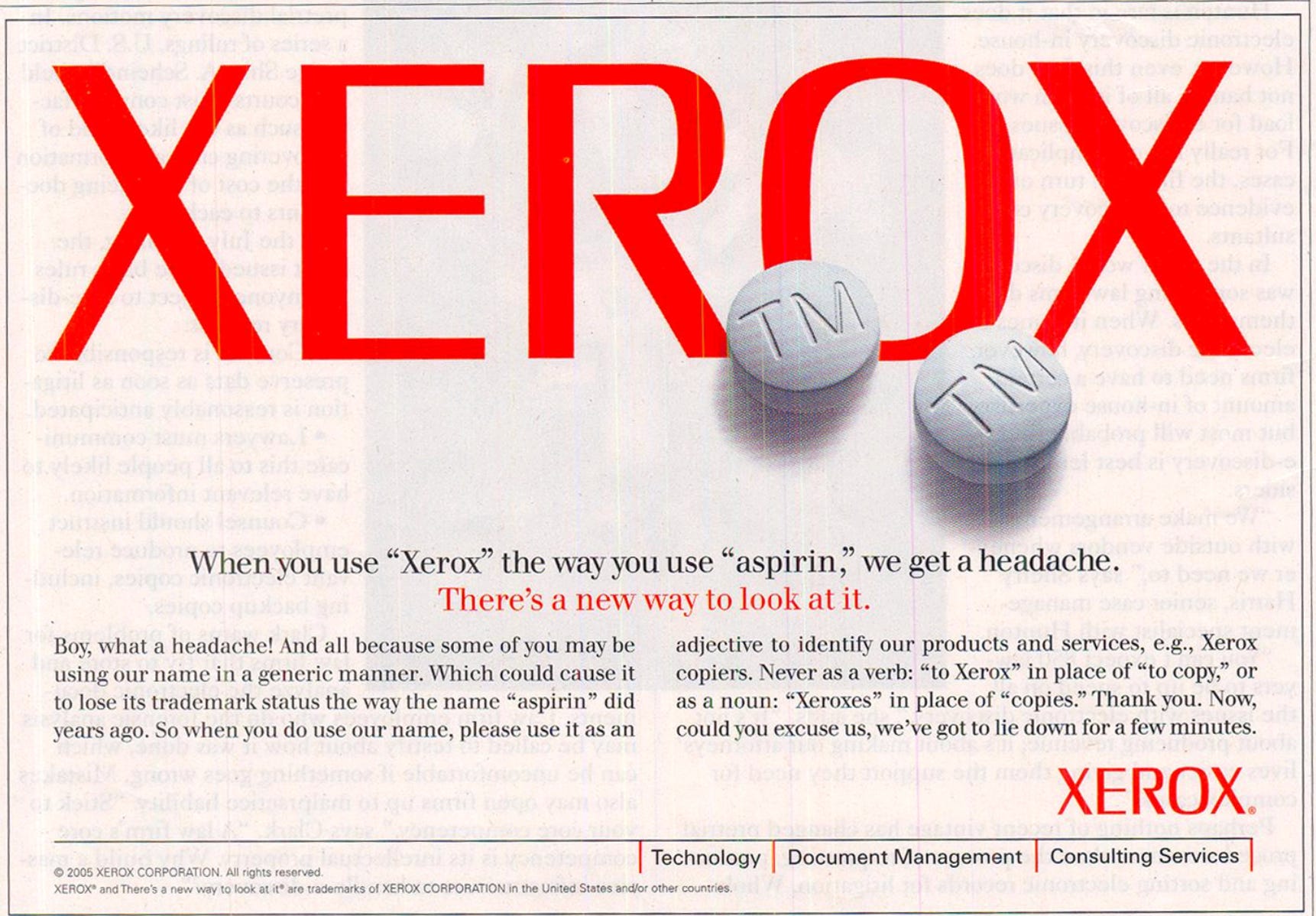
By the time I entered the workforce as a journalist a few decades later, Xerox was running ads in journalism trade journals asking people not to use “Xerox” as a synonym for “copy,” because of the risk that their trademark would eventually lose its protection.
(Among their memorable ads: “You can’t Xerox a Xerox on a Xerox.”)
As for Carlson, he died of a heart attack on September 19, 1968, at age 62, reportedly while watching a movie in a Manhattan theater.
He’d ended up with something like $150 million. He spent his last years giving it away, more than $100 million in all, much of it anonymously.
He didn’t forget Otto Kornei either; Kornei received a block of Xerox stock.
Not bad for a guy who once couldn’t afford his own law books.
7 other moments from history this week
Sunday, October 18: “By authority from his Majesty the Emperor of Russia …” — Russian commissioner Captain Alexei Pestchouroff, speaking to U.S. Gen. Lovell Rousseau at the formal transfer ceremony on Castle Hill in Sitka on this day in 1867.
Monday, October 19: “The General congratulates the Army upon the glorious event of yesterday.” — George Washington, in general orders issued the day after Cornwallis surrendered at Yorktown on this day in 1781. To spread the joy, Washington also pardoned every soldier then in confinement and sent them back to their units.
Tuesday, October 20: “Quite honestly, there was no model, nothing similar to what I was doing.” — Dick Fosbury, years after his backward “flop” won Olympic high jump gold in Mexico City on this day in 1968 with an Olympic-record 2.24 meters.
Wednesday, October 21: “Good night, Shreeve.” — AT&T engineer B. B. Webb, speaking from the Navy radio station in Arlington, Virginia, to colleague H. E. Shreeve, who heard the words at the Eiffel Tower on this day in 1915 in the first connected speech to cross the Atlantic by radio.
Thursday, October 22: “Beauty belongs to all the people.” — President Lyndon B. Johnson, signing the Highway Beautification Act in the White House East Room on this day in 1965. The law, a top priority of Lady Bird Johnson, required states to control billboards and junkyards along the interstates or risk losing 10 percent of their federal highway funds.
Friday, October 23: “With iPod, listening to music will never be the same again.” — Steve Jobs, unveiling the $399 iPod in Cupertino on this day in 2001. Apple went on to sell more than 400 million of them.
Saturday, October 24: “This will be a highly successful enterprise.” — New York Gov. Franklin D. Roosevelt, dedicating the George Washington Bridge, then the longest suspension bridge in the world, eight months ahead of schedule on this day in 1931. When the bridge opened to traffic the next day, 7,098 cars crossed in a single hour, a world record.