

It’s Free for ALL Friday! Each week I keep track of some of the off-the-path things I've found, and work extra-hard to make sure you never hit a paywall, using my own subscriptions, gift links, and other (legal) hocus-pocus.
Analysis Suggests School Was Hit Amid U.S. Strikes on Iranian Naval Base
The Feb. 28 school strike in Minab, which killed dozens, including children, appears to have been part of an attack on an adjacent naval base in southern Iran
The strike that hit an elementary school in the southern Iranian town of Minab is the deadliest known episode of civilian casualties since the United States and Israel attacked Iran — and no side has yet taken responsibility.
But a body of evidence assembled by The New York Times — including newly released satellite imagery, social media posts and verified videos — indicates the school building was severely damaged by a precision strike that occurred at the same time as attacks on an adjacent naval base operated by the Islamic Revolutionary Guards Corps.
The school at one point was part of the Revolutionary Guards’ naval base, according to satellite images from 2013 reviewed by The Times... But by September 2016, satellite images show, the same building was partitioned off and was no longer connected to the base.
Jeffrey Lewis, a professor at Middlebury College who specializes in satellite imagery, believes it’s possible American military planners had not updated their target sets. “There are thousands of targets across Iran, and so there will be teams in the United States and Israel that are responsible for tracking those targets and updating them,” he said. “It’s possible that the target didn’t get updated.”
Iranian health officials and state media said the strike had killed at least 175 people, many of them children, at the Shajarah Tayyebeh elementary school.
Link: New York Times (Aaron Boxerman)
Iranian Student: ‘Isn’t It Ironic That We Want War on Our Own Country?’
For many opponents of Iran’s regime, news of the supreme leader’s death brought elation. But there are concerns that regime change is incomplete.
The Iranian university student had risked his life in protests in Tehran for regime change, so when news broke of the first waves of American and Israeli strikes in late February, he felt shock – and overwhelming disbelief.
“I was having breakfast and checking my phone without concentration. My eyes popped out when I saw news about the attack: That was it, the very moment I had been longing for,” recalls the civil engineering student. He gave the name Mohammad, a pseudonym, for security reasons.
The death of Iran’s supreme leader, Ayatollah Ali Khamenei, in the first moments of the attack was an even greater shock... “My roommate and I were screaming in joy from our [east Tehran apartment] balcony when Trump officially confirmed [Mr. Khamenei’s] death,” says Mohammad. “The entire alleyway was blasting in excitement; all the neighbors were screaming from the bottom of their hearts.”
“Isn’t it ironic that we want war on our own country? Doesn’t it tell you about the level of our frustration?” asks Mohammad. “I personally believe marg yek baar, shivan yek baar, ‘either die once, or mourn once.’ We cannot suffer forever, so fleeting suffering in war is better than the destruction of another generation.”
Link: Christian Science Monitor (Scott Peterson)
Confidential Database Reveals Which Items NPS Thinks May ‘Disparage’ America
Park managers have flagged hundreds of materials at national park sites in response to Trump orders to scrub sites of content that might “disparage” Americans
At the Emmett Till and Mamie Till-Mobley National Monument in Mississippi, staff members asked the Trump administration to review an entire exhibit on the Black teen’s brutal 1955 killing by White men and his mother’s decision to publicize it — though the park’s staff warned that its removal would leave the site “completely devoid of interpretation.”
At Arches National Park in Utah, park managers wondered whether a sign about the damage that graffiti and invasive species leave on the iconic red rock landscape violates a Trump directive to focus solely on America’s natural beauty... These displays and materials are among several hundred that managers have flagged at hundreds of national park locations since last summer in response to administration orders to scrub sites of “partisan ideology,” descriptions that “disparage” Americans, or materials that stray from a focus on the nation’s “beauty, abundance, or grandeur.”
At Harpers Ferry National Historical Park in West Virginia, staff members have asked federal officials to decide whether a document that describes an abolitionist’s murder by a mob might “denigrate the murderers”... “The impact is that the visitors are just not going to get true, accurate stories,” said Bill Wade, executive director of the Association of National Park Rangers.
Link: Washington Post (Karin Brulliard, Brady Dennis)
Tax Haven, USA
Mapping the tiny tax shelters scattered across America
Teterboro is more a mall than a town, with a Walmart, a Costco, an Outback Steakhouse, and dozens of industrial businesses flanked by two highways — and about 60 residents. It holds $455 million in property tax wealth, or $7.3 million per resident, 45 times more wealth per capita than Teterboro’s surrounding metro area. The Teterboro website boasts that they offer the lowest tax rates in the county.
Teterboro is pretty unique, but it isn’t entirely alone. The United States is dotted with hundreds of similar enclaves that function as miniature tax havens for property tax wealth. In a new study published in the Socio-Economic Review, the researchers Brian Highsmith and Robert Manduca analyzed 138 million property tax records across America to assemble a list of more than 500 municipalities in which the taxable wealth per capita is more than three times that of the surrounding metro area.
The wealth these municipal tax havens hold is enormous — they’re filled with multimillion-dollar homes and prosperous business centers. The top 100 most fragmented enclaves the report identified hold more than $200 billion in property tax wealth. The top 500 hold more than $1.2 trillion... “This fiscal distress is not inevitable, nor even necessarily linked to deindustrialization or broad economic trends,” says Highsmith. “It reflects, at least in part, the way that the US fiscal system allows wealth to evade redistributive local taxation.”
Link: Business Insider (Guthrie Scrimgeour)
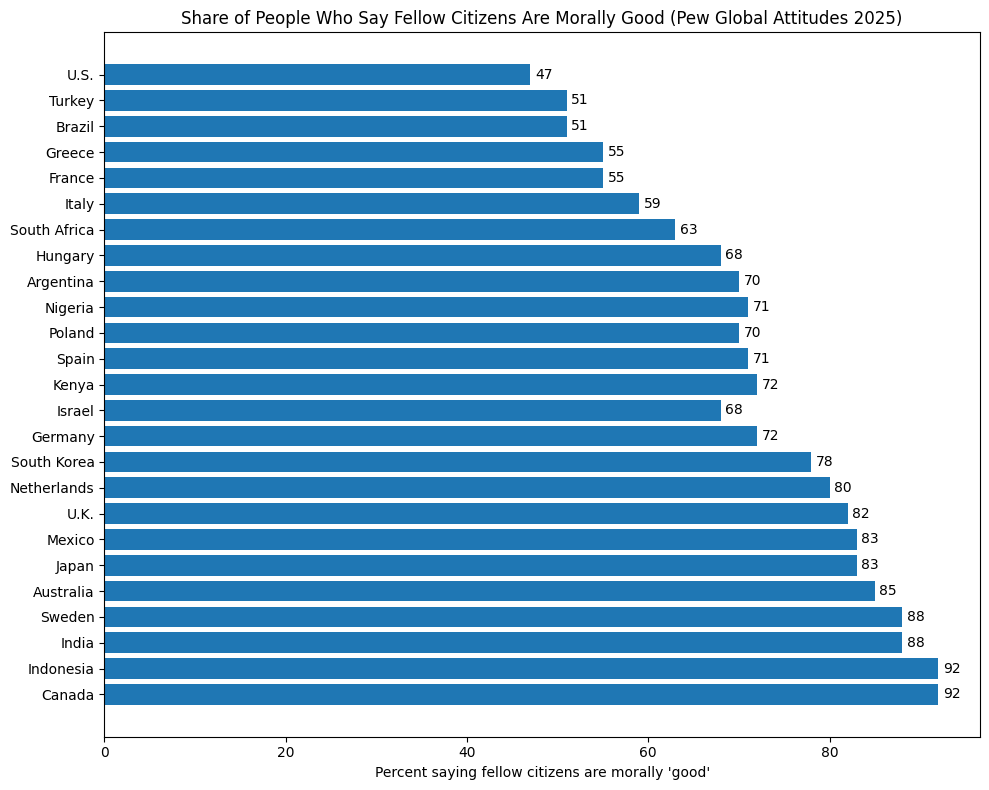
In 25-Country Survey, Americans Especially Likely to View Fellow Citizens as Morally Bad
53% of U.S. adults say their fellow Americans have bad morals and ethics. Among Canadians, 92% say their fellow citizens are basically “morally good.” (See chart at the top of this whole page.)
Americans are more likely than people in other countries surveyed in 2025 to question the morality of their fellow countrymen, according to Pew Research Center surveys in 25 countries.
In nearly all countries surveyed, more people say that others in their country have somewhat or very good morals than say their compatriots display somewhat or very bad levels of morality. The United States is the only place we surveyed where more adults (ages 18 and older) describe the morality and ethics of others living in the country as bad (53%) than as good (47%).
Because we have never asked this question before, we don’t know whether a majority of Americans have long held a skeptical view of the ethics of fellow Americans, or if it’s something new – and if so, what’s driving it.
But partisan politics appear to play a role. Democrats and independents who lean toward the Democratic Party are much more likely than Republicans and Republican leaners to rate fellow Americans as morally and ethically bad (60% vs. 46%).
GLP-1 Drugs May Fight Addiction Across Every Major Substance, According to a Study of 600,000 People
People taking GLP-1 drugs often talk about “food noise” vanishing—but patients report the preoccupation with smoking, drinking and drugs going quiet too
A patient of mine, a veteran who had tried to quit smoking for over a decade, told me that after he started a GLP-1 drug for his diabetes, he lost interest in cigarettes. He didn’t use a patch. He didn’t set a quit date. He simply lost interest. It happened without effort.
Another patient on one of these drugs for weight loss told me that alcohol had lost its pull – after years of failed attempts to quit... As a physician whose patients are often on GLP-1 drugs, and as a scientist who works on answering pressing public health questions, I saw a problem hiding in plain sight: Many addictions have no approved treatment.
In the group already struggling with addiction, there were 50% fewer deaths due to substance use among those taking GLP-1 drugs compared with those who were not. We also found 39% fewer overdoses, 26% fewer drug-related hospitalizations and 25% fewer suicide attempts. Over three years, this translated to roughly 12 fewer serious events in total per 1,000 people using GLP-1 drugs – including two fewer deaths.
Link: The Conversation (Ziyad Al-Aly)
The New Rules of Finding a Job in 2026
Many US workers are looking for a new role. Here’s how to stand out and use AI to your advantage.
Looking for a job in 2026 isn’t pretty. AI and mass applying mean most resumes never reach a human, and even interviews are increasingly handled by bots.
For job seekers, that has meant fewer responses, less transparency and growing uncertainty about how — or whether — to use AI themselves. Used poorly, it can hurt applications by making them seem generic or inauthentic. Used well, it can help candidates target roles, refine materials and prepare for interviews.
Career coaches say candidates are better off writing their own resumes before asking chatbots for critical feedback. Using AI to generate your resume risks introducing hallucinations — the errors produced when a chatbot invents information... Tactics such as hiding keywords or instructions for AI-powered screening systems in white font, hoping the software will read the hidden text, can backfire. “Most AI screening systems are programmed to catch these little cheats,” said Catherine Fisher, a career expert at LinkedIn.
“If you’re still waiting for someone to give you permission or hand you a tool and teach you to use it, then you’re probably not where most companies need you to be two-plus years into this,” said Bonnie Dilber, who leads a team of recruiters at software company Zapier.
Link: Bloomberg (Jo Constantz, Josyana Joshua)
Some fun…
https://www.instagram.com/reel/DVgU00Ojf1J/?igsh=dG8xYWc0ZjViY3p2
hii- I saw you were also in the top 100 health & wellness. I’m 29 and pretty new to substack. Sharing everything health, faith and fashionI in my healing journey after beating cancer twice. Check out my homemade healthy matcha recipe I posted today 💌🍵