
Of all the many people I’ve written about over the years, one who stands out was the former multibillionaire Chuck Feeney.
Feeney made his fortune co-founding an enormous duty-free business (the kind you see in airports), but then later made it his life’s mission to give away almost every last cent of his net worth to charity.
It was Feeney who gathered a group of fellow billionaires like Warren Buffett, Bill Gates, Oprah Winfrey, and Mike Bloomberg to a restaurant in New York City in 2009 and pitched them on the idea of the Giving Pledge, in which ultra high net worth people agreed to leave at least half of their fortunes to charity.
And, he set the example, giving away a total of $8 billion personally before his death three years ago.
I’ve always liked Feeney’s story, and I think for two reasons:
First, because it shows an example of a very successful person who managed not to become attached to money and let it own him.
Second, because in order to give away a lot of money like this, you first have to be the kind of person who creates a business that is actually worth that much.
All of which brings us today to Eddie Smith Jr.
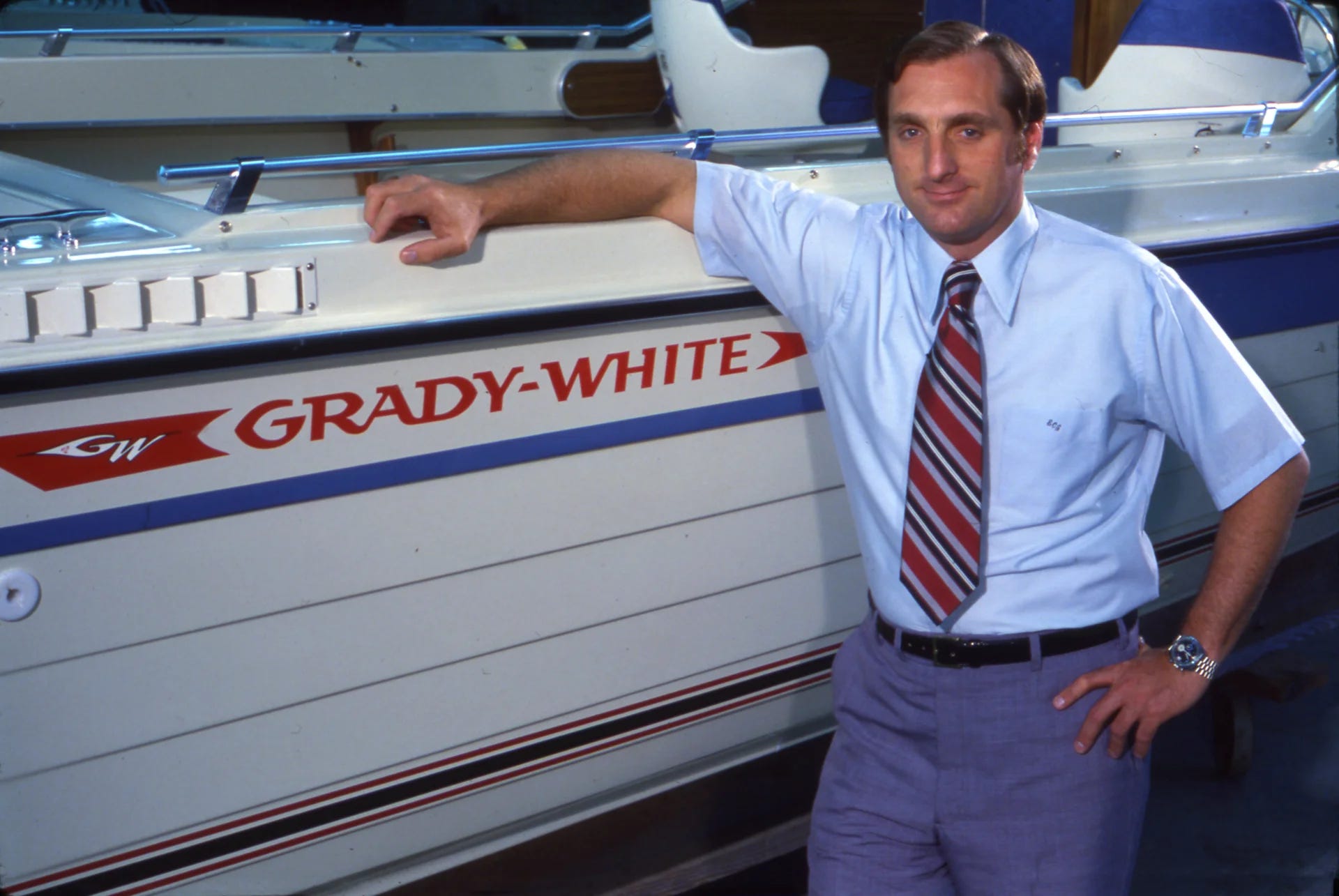
In 1968, when Smith was in his 20s, he borrowed some money from his dad to buy a struggling boat-building company called Grady-White Boats in Greenville, N.C.
Over the next almost-60 years, Smith built it into a highly successful company. As many entrepreneurs do, he started thinking about his legacy, and hoped that his son Chris might one day take over the business.
Tragedy struck, however. Smith’s wife Jo Allison passed away in 2020, and the following year Chris died at age 57, from amyotrophic lateral sclerosis, also known as Lou Gehrig’s disease.
Wondering what to do with the company, Smith hired an investment bank to test the waters for a sale. Appetites were strong, with bids coming in at over $400 million.
But then, he started having second thoughts.
“I’ve had so many friends who sold companies,” Smith told me when I had the chance to interview him recently, “and none of them were happy after the sale with what happened to their companies. They just lost their way. They lost their culture.”
Then, he found another solution, after reading an article in the New York Times about how Yvon Chouinard, the founder of Patagonia, gave away his company stock to a nonprofit organization that would dedicate Patagonia’s future profits to support causes he cared about.
Credit where it’s due: I first learned about Smith’s story in another Times article, which frankly is also where I first learned about this entire option.
The legal mechanism involves something called a purpose trust, which now holds all the voting shares of Grady-White Boats, combined with a separate nonprofit.
Grady-White continues as a company, bound by Smith’s values, and will likely provide tens of millions of dollars a year in support of causes Smith identifies such as education, health care, and conservation.
“It’s not just a matter of picking the right people with the right character,” explained Natalie Reitman-White, a consultant who helped Smith explore his options and set up the arrangement. “It’s actually a fiduciary duty, they’re duty-bound to ensure the company operates to the values, principles, and outcomes that you put in the trust agreement.”
Things I really like about this outcome:
First, it protects the culture and values. That was clearly paramount in Smith’s mind.
Second, it protects employees and other stakeholders.
Third, I think it lets entrepreneurs continue doing something that many find very satisfying — betting on themselves.
To be clear, it’s still a remarkable thing for someone like Feeney to liquidate his holdings and donate the money outright.
But maybe it’s even more interesting for someone like Smith to decide:
You know … I think I’ve built something here that can endure long beyond me, and continue creating value and supporting things I care about well into the future.
And, I think the things I’ve created can do it better than anyone else I might give the money to and simply trust their judgment.
As Smith put it:
“Grady-White has a soul. Not very many companies that I’m aware of have a soul, and we just want to make darn sure that it continues to be that way. …
I realized I could secure the awesome culture that Grady-White has got, and really lock that down for generations and generations.”
Oh, and I guess there’s one more thing I like about the story.
In order to give away the profits from a company like this, you first have to be the kind of entrepreneur who creates a business that is actually worth that much.
Where have I heard that line before?
Other things worth knowing …
CBS News Minnesota: Minnesota Attorney General Keith Ellison on Tuesday announced he is suing Texas Gov. Greg Abbott over the extradition of an immigration agent accused of shooting a man in Minneapolis. Christian Castro, the ICE agent, is Castro is charged with four counts of second-degree assault and one count of falsely reporting a crime. Texas Rangers arrested him on May 29 and he has been held at the Cameron County Jail ever since.
The New York Times: Silicon Valley Executives Are Tech Fans. Just Not for Their Own Kids: At home, moderation and restraint are the rule for tech parents. Boredom is exalted. Maybe they're onto something.
The Washington Times: Pennsylvania Attorney General Dave Sunday announced charges against 14 people in connection to a cocaine-trafficking operation involving primarily college students and two fraternities at Penn State University. Thirteen of the defendants were Penn State students at or around the time of the alleged conduct, in 2023 and 2024, while the 14th defendant is the father of a student.
Deadline | Showbiz411: I haven’t watched a late-night talk show in a very long time, but I have to say I find it kind of funny that of all the guest hosts they could have come up with for Jimmy Kimmel Live, they recruited Rosie O’Donnell—especially given that ABC filed an unprecedented First Amendment lawsuit against the FCC on Tuesday, claiming that its investigations and regulatory actions are part of a Trump administration “retaliatory campaign” to curb the network’s free speech.
SFGate: Employers are ghosting college grads and rescinding offers, destroying morale. A June 2026 report from Resume Builder, which included survey responses from 1,000 respondents between the ages of 20 and 28 who graduated with a bachelor’s degree within the last year, said 34% percent reported having had a job offer rescinded right after accepting it.
New York Post: COVID created a permanent class of young shut-ins, according to a stunning new report. Nearly 10% of Gen Zers said they had zero face-to-face interactions with another person in their daily life, according to an analysis of US Census data by the Financial Times. The dangerous trend was triggered by the COVID pandemic, when millions of young people were kept stuck inside during the years spent developing crucial social skills.
UPI: A bear wandered through an open front door into a Harlan County, Kentucky home, ate a family's leftover KFC and knocked over a glass table. "I'm a little sad over my KFC," homeowner Kendra North said, adding, "I keep that front door shut good though at night now, and apparently 7 p.m. is bear time now too."
Thanks for reading. Photo courtesy of Grady-White Boats. I wrote about some of this at Inc.com. See you in the comments!
My father's cousin went to high school with Chuck Feeney, and they graduated from a high school in Elizabeth, NJ. He was from a poor family and appreciated the high school education that helped him to become such a successful businessman, and when he sold his company, becoming a billionaire in the process, he decided to invite EVERY member of his high school class ( and spouses) on an expense paid trip with him to Ireland! My father's cousin. Barbara said he was the most down to earth, humble, thankful man and a joy to be around.
Love the story about Smith. Do you think Ben & Jerry ice wish they something similar ?