

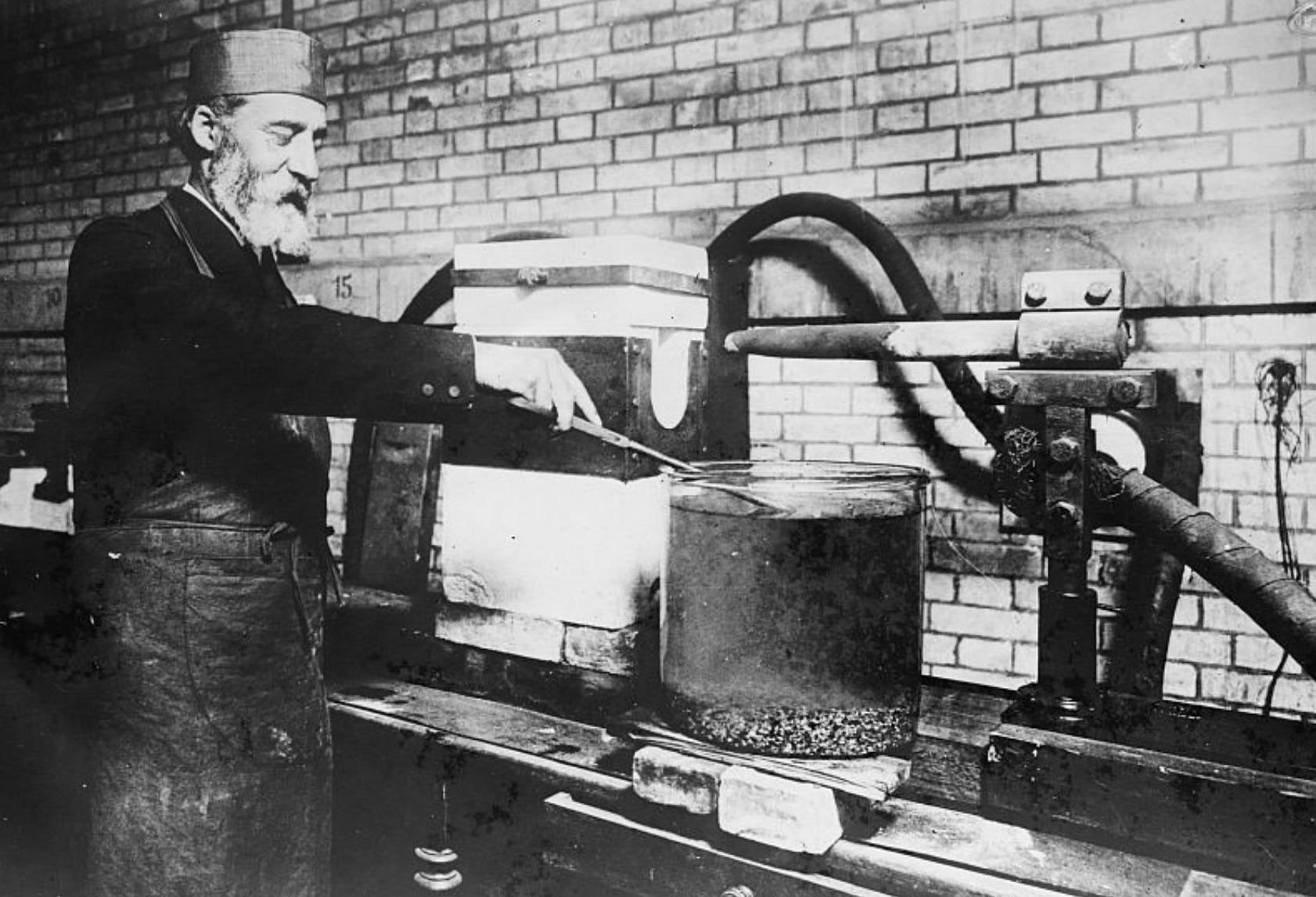
This is the story of a 19th century chemistry discovery that affects our lives in many ways today, and that most people are completely unaware of.
Let’s change that, starting our narrative in 1852, when a boy named Henri Moissan was born in Paris.
The son of a railway employee and a seamstress, Moissan became an apprentice clockmaker, but then wound up in the army during the Franco-Prussian War (1870; saved you a Google). Afterward, he switched careers, so to speak, and became a trainee chemist in a pharmacy.
He apparently received some renown after saving a patient who had been poisoned with arsenic, and had the chance to go back to school — earning a doctoral level degree at age 28, in 1880.
This background placed Moissan perfectly to take up a quest that had flummoxed European chemists for more than 70 years at the time — the attempt to isolate an element that they were convinced existed, but that had never been directly observed.
This was fluorine — the last halogen anyone hadn’t managed to isolate, and the one that kept killing the people who tried.
I don’t think it’s too much to say some parts of the chemistry world at the time were obsessed with this question, to the point that several scientists chased after it to the point of serious injury or death:
A Belgian chemist named Paulin Louyet tried to isolate it and died of poisoning.
A Frenchman named Jérôme Nicklès tried next, knowing exactly what had happened to Louyet, and died the same way.
Two Irish brothers, Thomas and George Knox, both attempted it in the 1830s; Thomas nearly died, and George was disabled for three years afterward.
Chemists started calling the dead and injured the “fluorine martyrs.”
None of them knew exactly what they were dying for; they just knew something was in that rock, and it was killing the people who went looking for it.
Fluorine, once freed from its compounds, is the most reactive element on the periodic table. It corrodes glass. It ignites substances that don’t normally burn. Every 19th-century chemist who went after it was handling something that wanted to combine violently with whatever it touched, including human tissue.
Using a borrowed laboratory, Moissan took up the quest.
Moissan built a custom electrolysis apparatus out of platinum and iridium, the only materials that could resist what he was trying to produce, sealed with stoppers carved from fluorite itself. He cooled the whole system to -50°C to slow the reaction down enough to survive it.
He poisoned himself with his own apparatus more than once.
Then, on June 26, 1886, he ran an electric current through a solution of potassium fluoride dissolved in hydrofluoric acid, inside his platinum apparatus, at fifty degrees below freezing. A pale yellow-green gas collected at one electrode.
Fluorine. Isolated, alone, for the first time in human history, after roughly seventy years of failed attempts and at least four deaths along the way.
The French Academy of Sciences sent three of its most distinguished members to confirm it. It held.
Moissan spent the following years studying the element’s properties and building an electric furnace capable of reaching temperatures over 3,000°C — itself a major advance, used to produce industrial compounds that had been impossible to create at lower heat.
In 1906 he won the Nobel Prize in Chemistry. The committee’s citation called fluorine “that savage beast among the elements” and praised the skill with which Moissan had tamed it.
He died the following February, at 54, officially of appendicitis, though some historians have wondered whether decades of fluorine and carbon monoxide exposure played a role.
None of the dead and disabled men of the 19th century actually knew what fluorine would be used for, of course. So here’s a list of some of the things their work led to:
Roughly a fifth of modern pharmaceutical drugs — including widely prescribed antidepressants and cholesterol medications — contain fluorine atoms, added because they make the drugs more stable and effective in the body.
Hydrofluoric acid, a fluorine compound, etches the silicon wafers inside every computer chip and smartphone on Earth.
Teflon — chemically inert, heat-resistant, used in everything from frying pans to surgical implants to spacecraft components — exists because fluorine chemistry exists.
Fluoride compounds in toothpaste and drinking water prevent tooth decay for billions of people.
Uranium hexafluoride, the only stable, gaseous uranium compound, is what makes uranium enrichment for both nuclear power and nuclear weapons possible at industrial scale.
Granted, early refrigerants made from fluorine compounds were celebrated for being inert and non-toxic—but they turned out to be destroying the ozone layer. So, they were phased out worldwide starting in the late 1980s.
Very few people knew what was going on in Moissan’s borrowed lab 140 years ago this week. Heck, very few people know today! But now you’re an exception.
Thanks for reading.
Now that I’ve finished writing this newsletter on a chip-infused computer and you’re done reading it on your chip-infused smartphone, I’m off to make scrambled eggs in a nonstick pan and then brush my teeth.
7 optimistic moments from history this week
June 21: “I was singing to God and I was saying that God was the Tambourine Man and I was saying to him, ‘Hey, God, take me for a trip and I’ll follow you.’ It was a prayer of submission.” — Roger McGuinn, lead singer of the Byrds, describing the spiritual undertone behind the band’s cover of Bob Dylan’s “Mr. Tambourine Man,” the opening track of their debut album of the same name, released on this day in 1965.
June 22: “One more of the emotionally charged and at times dramatic pages in Berlin’s post-war history has been turned.” — Soviet Foreign Minister Eduard Shevardnadze, speaking at the ceremony in Berlin on this day in 1990, when a crane lifted the guardhouse at Checkpoint Charlie off its foundation and carried it away.
June 23: “No person in the United States shall, on the basis of sex, be excluded from participation in, be denied the benefits of, or be subjected to discrimination under any education program or activity receiving Federal financial assistance.” — The full text of Title IX, signed into law on this day in 1972. The law is best known today for transforming women’s college athletics.
June 24: “It came spasmodically from a chain of nine circular-type aircraft way up from the vicinity of Mount Rainier... [like] “a saucer if you skip it across water.” — Kenneth Arnold, an Idaho pilot and search-and-rescue volunteer, describing what he saw on this day in 1947. Newspapers garbled his description into “flying saucers,” a phrase that didn’t exist the day before and has never left it since.
June 25: “How proud Anne would have been if she had lived to see this.” — Otto Frank, the only member of his family to survive the Holocaust, on the publication of his daughter’s diary in the Netherlands on this day in 1947, under the title Het Achterhuis — “The Secret Annex.”
June 26: “History will honor you for it.” — President Harry Truman, addressing the delegates of 50 nations who had just signed the United Nations Charter in San Francisco on this day in 1945, seven weeks before the war in the Pacific finally ended.
June 27: “Captain, our adventures have been a little different.” — Theodore Roosevelt, greeting Joshua Slocum, the first person in history to sail solo around the world, who had completed his voyage on this day in 1898 after more than three years and 46,000 miles alone aboard a 37-foot rebuilt oyster boat. Slocum’s reply: “That is true, Mr. President, but I see you got here first.”
Wow, what a great set of facts to start the week learning about. Who knew? Definitely not me. And here I thought Flouride was a simple toothpaste compound. This is why this is the best newsletter and best way to start the day. Interesting, educational and just well written. These history to today articles are among my favorites!
Interesting. I enjoy historical facts like these. We take much for granted when story is unknown. Thanks.