

I’m sitting in a doctor’s office as I write this, waiting for him to come back and pump cortisone shots into my 56-year-old shoulders.
Goals: Manage the pain and get through ski season. Do the rehab.
Then we’ll figure out if we have to do anything longer-term.
But that’s not why I’m telling you this.
The reason is that I’ve been here before, literally, although I didn’t realize it until today because I came in the other side.
Maybe some of you will remember this:
(AKA, perhaps, screaming into the void from the front seat of a 2014 Ford Explorer.)
Then, I looked up and saw a sign with a quote bolted in front of me:
“Life becomes easier when you learn to accept the apology you never got.”
— R. Brault
Mind blown.
I wrote about it, and I even got to exchange emails with “R. Brault.”
The “R” stood for “Robert,” as it turned out. We traded a few emails.
He was 85 then and retired with little desire to rehash pithy quotes he’d come up with years before.
But you generous people (or else, your predecessors) bought about 45 copies of his books as a result of me quoting him, so he didn’t hate me.
Anyway, welcome back to Overthinking Island.
I came across a new study out of Ohio State about empathy and forgiveness.
Since I’m a lot of fun at parties, I realized it offers an interesting scientific perspective on that quote.
Writing in the journal Frontiers in Psychology, Angus Fletcher and Mark Matthews conducted three studies involving 1,563 people.
Specifically, they came up with a story about a woman named Mary who watched as her puppy was hit by a car when she was a child, and shared it with the group:
For decades, Mary swears off having another pet. But at age 85, she finally adopts another dog to heal her grief.
She hires a repairman to do some work at her home, and she warns him to keep the door closed.
But he fails to do so, and Mary’s new puppy runs away. To Mary’s horror.
The researchers offered study participants different versions of the next part of the story:
In Version 1, the repairman left the door open because he simply ignored Mary’s warning.
In Version 2, he was distracted by personal issues.
But — the plot thickens! — the whole experiment comes down to what the repairman says or thinks afterward. Either —
He says to Mary afterward, “I wish I didn’t leave the door open.”
Or, he says nothing, but still thinks to himself: “I wish I didn’t leave the door open.”
Thus, in one version, readers only know that he tells Mary he regrets his action. In the other version, readers actually know what he thinks because we can read his thoughts—even though Mary can’t.
Experimental result: Readers who knew that the repairman privately regretted what he’d done were more likely to forgive him than readers who only knew what he’d said out loud.
Then, the researchers repeated the experiment with another 449 people, but added something else: study participants were asked to think about a time in their lives when they had been wronged.
Readers who found they forgave the fictional repairman character for what he’d done to the fictional Mary were more likely to say they forgave the person who had wronged them in their real-life example.
Draw a conclusion. I dare you. Researcher Matthews was game:
“Once we know the transgression is someone’s fault, what we discover is that if we can create a condition where you can see the internal remorse, the internal world of the person, people can feel the sincerity of it.
They can open up and connect with the emotions that person is having. As a result, now we have the opportunity to forgive them more.”
Now, obviously, we’re talking about fictional people here. In real life, we don’t get to read other people’s thoughts.
Maybe the person who wronged you regrets what they did. Maybe they don’t.
Maybe they know, but they wouldn’t have known how not to do whatever they did anyway.
Or else, maybe they know and they don’t care.
In that last case, you’re never going to get an apology no matter what. And, it also means they have no idea whether you’d be willing to accept said theoretical apology.
As satisfying and healing as an apology can be, it sure gives that person a lot of power if you’re waiting for them to offer one.
See what I’m getting at?
Find your own solution.
Cortisone and contrition.
They can both work!
Thank you for reading Understandably! If someone shared this with you, please sign up here for a free or paid subscription. I’m also grateful for one-off support (via Buy Me a Coffee) that helps me keep this whole thing going!
Other things worth knowing …
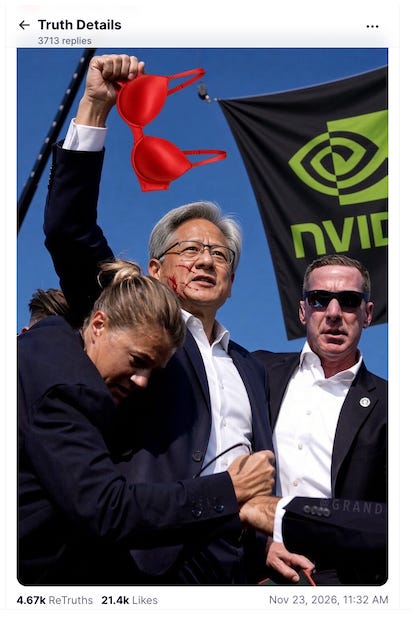
NYT | CNBC: Nvidia reinstated Jensen Huang as president and CEO less than two weeks after he abruptly resigned following reports of two extramarital relationships, including one with a woman who U.S. intelligence identified as a Chinese asset. Nvidia’s stock jumped more than 30 percent. President Trump took credit, and posted about it on Truth Social: “I spoke to them, let me put it that way. And I convinced them. I made the deal,” Trump told CNBC, adding that Huang “did nothing wrong.”
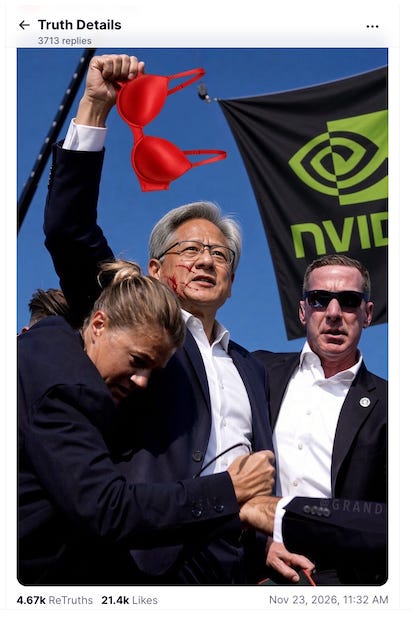
WSJ: The Frantic White House Push to Get Jensen Huang Back: Trump made clear he wanted the Nvidia CEO reinstated; on Monday he touted the decision, saying the market proved it was right.
ABC News: Ukrainian President Volodymyr Zelenskyy confirmed that Kyiv was responsible for the sinking of a Russian warship docked in the Libyan port of Benghazi on Sunday. The Russian corvette Merkury, which was commissioned in 2023, was at port when it was hit by several explosions. “Our warriors deployed seven Ukrainian-made naval drones. Despite all the enemy’s efforts to counter the attack, the Russian corvette Merkury was sunk,” Zelenskyy wrote.
PBS: An appeals court struck down a federal law requiring workplaces to provide accommodations for pregnant women, saying Congress violated the U.S. Constitution when it passed the law in 2022. In a 9-8 decision, the 5th Circuit Court of Appeals, which covers Texas, Louisiana and Mississippi, said the act was unconstitutional because a majority of U.S. House members weren’t physically present when it was approved as part of a spending package in December 2022. At the time, the House was operating under COVID-era rules that allowed members to vote by proxy.
The Atlantic: License Plate Readers Are a New ICE Surveillance Superpower: Officers have been using license-plate readers to randomly find more people to arrest.
CNBC: Lawsuits against Elon Musk’s SpaceX are stacking up, as Virginia and Oregon sued the company over issues with its Grok AI image generator. Versions of Grok and SpaceX’s social network X have enabled users to generate and distribute explicit deepfakes based on real photos or videos of children and other people who did not consent, according to research by the Internet Watch Foundation, the Center for Countering Digital Hate and others.
AP: What were once long-shot ideas around universal healthcare have suddenly been catapulted to the forefront of the Democratic agenda for the new Congress. Rep. Hakeem Jeffries of New York, on track to become House speaker, announced his intentions to take steps toward Medicare for All, including proposals to lower the Medicare eligibility age below 65, add dental, vision and hearing aid benefits, and open up healthcare to children. About 6 in 10 voters nationally say the federal government should play a bigger role in helping Americans get healthcare.
AP: The United States is going to be a soccer World Cup host again in 2031 and England will do so for the first time since 1966. FIFA on Monday confirmed the U.S. will lead a four-nation, regional co-hosting of the 2031 Women’s World Cup — with Mexico, Costa Rica and Jamaica — and a UK project led by England was ratified for the 2035 edition.
404 Media: Google has filed for a patent that would use the information it knows about you to create an AI-generated TV channel full of personalized “shows” starring you and featuring customized advertisements. The patent is the latest signal of the AI video endgame: endless highly specific, customized content that is automatically generated based on the wealth of data companies and advertisers collect about you.
Thanks for reading. Photo by Alonso Reyes on Unsplash. I wrote about some of this at Inc.com. See you in the comments!