
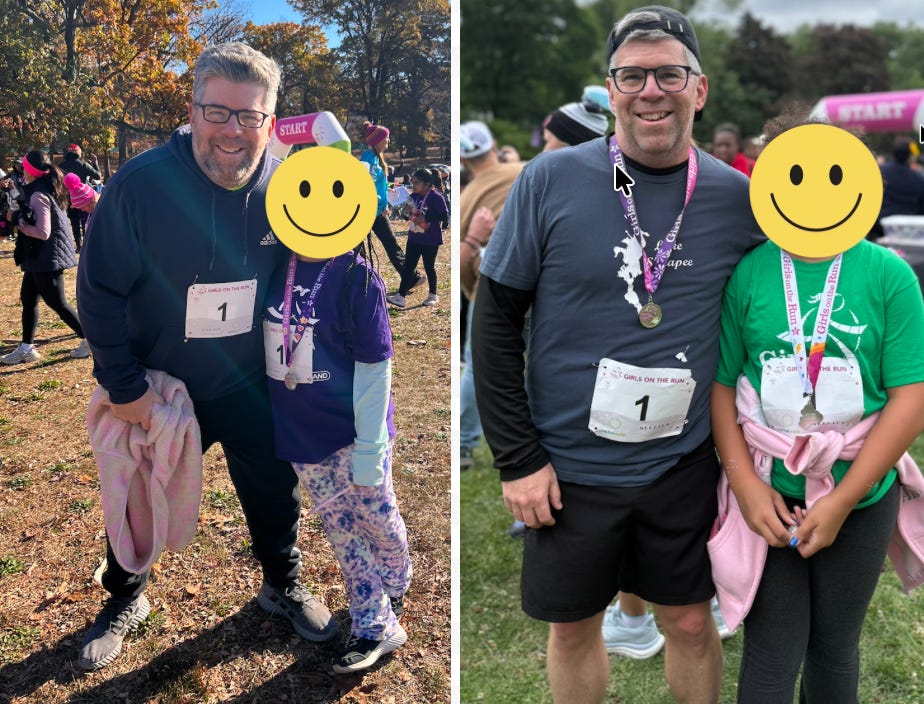
Earlier this week, I wrote about a major new study linking GLP-1 drugs to significant reductions in depression, anxiety, and substance use disorders — and I mentioned that I’ve been taking one myself for about a year and a half.
It worked. Honestly, this might be the first time I’ve offered a before-and-after photo in this newsletter. And the drug wasn’t the only thing I did; I now spend a lot of time in the gym, and my diet is much better.
But if you haven’t enabled images, the photo above is the difference between me in November 2024 at the nadir, fighting physics to finish a 5K with my daughter, and last weekend, when it was—well let’s just say a lot closer to my long-ago marathoning days.
All of which leads me to a separate study that came out last month, because it got my Irish up.
Researchers at Rice University, publishing in the International Journal of Obesity, studied how people perceive those who lose weight using GLP-1 drugs like Ozempic or Wegovy.
Their finding: people who lose weight on these medications face more social stigma than people who lose the same weight through diet and exercise. In some cases, more than people who don’t lose weight at all. The explanation the researchers point to: a widespread perception that GLP-1 drugs are “the easy way out.”
I have thoughts.
Thank you for the compliment
Allow me to offer a metaphor.
I have a full head of thick hair in my mid-50s, and I didn’t do anything to earn it — genetics, luck, whatever.
But I also don’t have strong feelings about men who are losing their hair. I’m glad they’re trying to explore medical options to address it.
Rogaine exists. Finasteride exists. People make their own choices about their own bodies, and I genuinely couldn’t care less what those choices are.
See what I mean?
The idea that someone who is biologically predisposed to carry more weight should be judged more harshly for using a medical tool to address it than for simply staying overweight strikes me as really weird.
I wouldn’t hesitate to tell you I took a drug for high blood pressure or high cholesterol.
I’d tell you about a knee surgery or a course of antibiotics.
I don’t get why a medication that happens to affect weight and metabolism would be treated differently — or why losing weight with its help would make someone more of a target for judgment than not losing weight at all.
‘The easy way out’
The Rice researchers ran a series of experiments in which participants evaluated people who had lost weight via GLP-1 drugs, via diet and exercise, or not at all.
Across the board, GLP-1 users were rated more negatively.
The stigma compounds if someone stops the medication and regains weight — which is common, because these drugs work while you take them, and stopping them often reverses the effects.
In that scenario, the researchers found, the judgment gets even harsher.
“There’s a narrative that using these medications is ‘taking the easy way out,’” said lead researcher Erin Standen. “And that belief seems to shape how people are judged.”
Caveats: this is experimental research using study participants rating hypothetical scenarios, not a longitudinal study of real-world social outcomes.
You do you
The researchers flag something practical: Stigma around these drugs may be contributing to the spread of misinformation about their risks.
If people are motivated to believe GLP-1 users are doing something wrong, they may be more receptive to exaggerated claims about side effects.
There’s also a more direct consequence.
If someone is on the fence about a medication that a growing body of research suggests can meaningfully improve physical and mental health — and they’re hesitating partly because of what other people might think — that’s a real cost.
I told my doctor when she first prescribed the drug that even without insurance coverage I’d consider paying out of pocket, because I felt like I was buying myself extra years of healthy life expectancy.
She said she wished everyone had that attitude. Heck, I think she was about to hug me, except for things like propriety, and patient-doctor relationships and all of that.
But we hugged in spirit.
As always — or at least as often — I’m not telling anyone what to do.
Using these drugs is a personal decision that involves doctors, insurance, individual health histories, and a lot of factors I’m not qualified to weigh in on.
But if you’ve been thinking about it and the “easy way out” framing has been any part of what’s holding you back — I’d encourage you to set that aside.
The people making that judgment probably haven’t thought very hard about what it actually means.
See you at the gym and the ski slopes, I hope.
Other things worth knowing …
ABC News — The House of Representatives on Wednesday adopted a resolution to curb President Donald Trump's Iran war powers by a vote of 215-208 — delivering a major rebuke to the administration's handling of the three-month-old conflict for the first time.
ABC7 — California primary results: Republican Steve Hilton leads the governor's race with 28%, and Democrat Xavier Becerra is in second with 25%, with Tom Steyer in third at 20% — meaning Hilton and Becerra appear headed to November's general election. Hilton said he "received a message of congratulations" from Trump.
CBS News — CBS News has fired longtime 60 Minutes correspondent and former CBS Evening News anchor Scott Pelley one day after he had a tense and confrontational exchange with new 60 Minutes executive producer Nick Bilton.
NBC News — Progressive politicians are sharpening their attacks against tech tycoon Elon Musk, zeroing in on his soon-to-be-trillionaire status days before his company SpaceX’s record-setting initial public offering. Musk will likely become the world’s first trillionaire shortly as soon as next Friday, June 12.
Bloomberg — SpaceX’s IPO will also likely make President Donald Trump’s already wealthy administration even richer. Ten officials ranging from special envoy Steve Witkoff to Small Business Administration head Kelly Loeffler reported financial interests in Elon Musk’s rocket company between $9.9 million and as much as $43.8 million, according to the latest disclosures.
New York Times — The Sun Is Shining on Lisbon: The Portuguese capital is booming with an influx of artists, retirees and visitors drawn to an exciting, affordable culinary scene and an inclusive culture.
National Geographic — Ten Reasons to Climb Kilimanjaro: Why do 40,000 people a year seek to climb the world’s highest freestanding mountain — a mountain so popular it has become known as “Everyman’s Everest”? Here are the top ten reasons, from the most practical to the most profound.
Thanks for reading. I wrote about some of this at Inc.com. See you in the comments.
Congratulations, Bill! You put in the work and deserve the results. And you are continuing to do the work to maintain those results. Your column today reminds me of a comment I get once in a while from others that I just hate. It is “you’re so lucky…”. No, I’m not lucky. I didn’t get a good grade in my class because of luck. I did my homework, studied for tests and asked for help when I needed it. No, luck had nothing to do with my living in this nice house. I worked hard, saved, invested carefully, planned, and I am now enjoying the fruits of that labor. I am proud of what I have and can say “I did this!“ No explanation is required here. You can be proud that you saw something you wanted, found out how to get there and did it. Yay!
I don't believe in taking any kind of drug for weight loss. I also don't believe in diet or exercise. If you want to lose weight, go live in France for a month and eat exactly like they do. Keep doing that for the rest of your life. You will find that you eat very, very well. You will drink wine and have desserts. This is known as the "French Paradox". It works. Don't get on a scale, except at the doctor's office. Get your exercise by walking and climbing stairs. Ride a bike. Do some yoga. Whatever you enjoy. Don't eat anything you don't like. But you will find that you lose interest in snacking all the time. Americans eat all day long. In France, the meals are so incredibly delicious and rib-sticking, that they stay with you. You won't want that bag of chips because you're feeling quite sated from the lunch you just had--a small plate of smoked trout, a chive omelet, a salad, and a sliced peach drizzled with raspberry sauce. Not a gigantic mile-high concoction loaded with meats and cheeses and sauce and thick bread. Plus two sugar-filled cokes and a brownie slathered with chocolate sauce. I'm serious--go to Paris and watch them. Walk to your next destination instead of hopping a cab. Have three excellent meals every day. You will remember at least one of those meals as long as you live.