

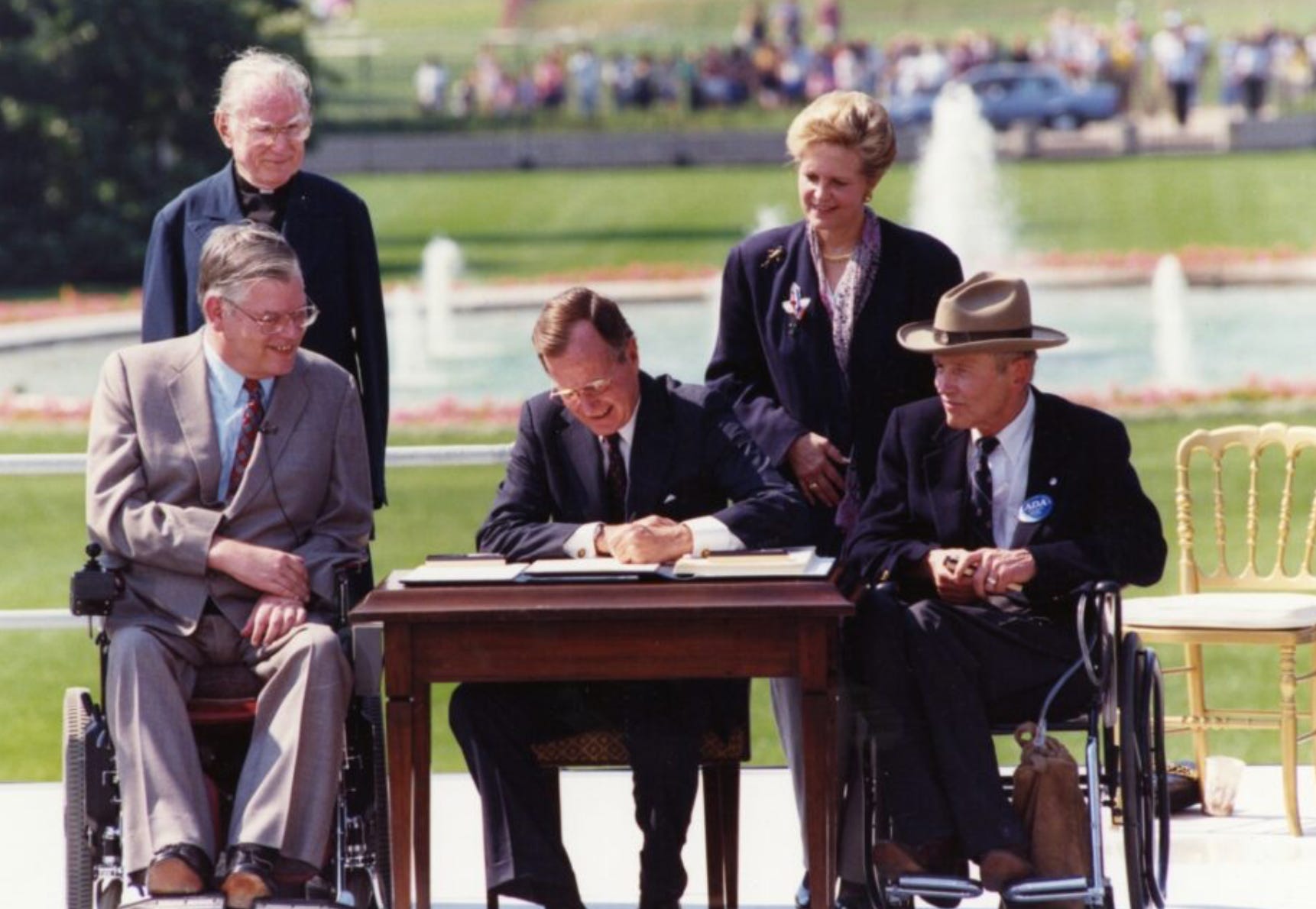
Justin Dart Jr. entered the world in Chicago in 1930 with just about every material advantage a person could have.
His mother was an heir to the Walgreen fortune, the granddaughter of the man who founded the drugstore chain. His father built a plastics and consumer-products company that eventually became Dart Industries, the company behind Tupperware.
There were maids in the house and a chauffeur to drive the family around. Nothing about Dart’s early life pointed toward hardship, much less a lifetime spent fighting for people who had been pushed aside.
Then, at 18, just as he was preparing to attend the University of Houston, Dart contracted polio. He survived, but he lost the use of his legs and would use a wheelchair for the rest of his life.
Years later, Dart called the onset of polio “the beginning of my good days.” He believed the experience forced him to confront his feelings of inadequacy and gave him a larger sense of purpose.
During his recovery, he read Gandhi. The ideas stayed with him.
Dart went on to earn degrees in history and education at the University of Houston. But when graduation approached, the university refused to give him a teaching certificate. Its position was blunt: a man in a wheelchair could not succeed as a teacher.
So Dart joined the family business.
He spent years working in Asia and eventually took charge of Tupperware’s operations in Japan. While there, he promoted women and people with disabilities into jobs that carried genuine responsibility and authority.
Executives in the United States told him to stop. Dart and his wife, Yoshiko, resigned instead.
The decisive break with corporate life came in 1966. During a business trip that took him through Saigon, Dart visited what he had been told was a rehabilitation center for children with polio.
He found children lying on a concrete floor without adequate food or care, apparently abandoned and left to die. One dying girl reached out and held his hand. Dart later said the memory had been burned into his soul.
Not long afterward, he walked away from corporate life.
For roughly the next 20 years, often working without pay, Dart served on disability commissions in Texas and in Washington. Under President Ronald Reagan, he became vice chair of the National Council on Disability. Under President George H.W. Bush, he chaired the Congressional Task Force on the Rights and Empowerment of Americans with Disabilities.
That title sounds bureaucratic. The work was deeply personal.
Dart traveled to every state, along with Puerto Rico, Guam, and Washington, D.C. He held public meetings where people with disabilities could explain what discrimination looked like in their own homes, schools, workplaces, neighborhoods, and daily lives.
More than 30,000 people took part.
Their testimony, gathered community by community, created the record Congress would later rely on when considering a sweeping civil-rights law for Americans with disabilities.
Dart was hardly an outsider storming the gates. He was a wealthy Republican with connections to two presidents. He had access, influence, and a family name that opened doors.
He chose to use those advantages for people who had spent their lives being denied access to almost everything.
On July 26, 1990, President George H.W. Bush sat at a small desk on the South Lawn of the White House and signed the Americans with Disabilities Act.
Nearly 3,000 people were there.
On Bush’s right sat Evan Kemp, who had muscular dystrophy. On his left sat Dart, wearing his familiar cowboy hat and a blue-and-white button bearing the letters “ADA.”
The bill had passed the Senate by a vote of 91–6 and the House by 377–28.
With Bush’s signature, the United States became the first country to enact comprehensive civil-rights protections for people with disabilities. The law addressed employment, transportation, public accommodations, and telecommunications. More than three decades later, it remains one of the most consequential disability-rights laws ever passed.
Dart died in 2002 at the age of 71.
When he is remembered today, he is often called the father of the ADA. It was a title he reportedly resisted.
The law, he insisted, belonged to the tens of thousands of disabled Americans who had come forward, told the truth about their lives, and demanded to be treated as full citizens.
7 other moments to know from history this week
July 26: “It just dared me even more.” — Sharon Sites Adams, describing her response to the skeptics — including Los Angeles newspaper editorials predicting she’d cost taxpayers a fortune when someone had to go rescue her — before she set out alone from Yokohama, Japan, in May 1969 to sail across the Pacific Ocean. Seventy-four days, 17 hours, and 15 minutes later, she sighted the California coast.
July 27: “Only God can know the sensation of this moment.” — A crew member aboard the SS Great Eastern, on this day in 1866, after the ship successfully completed the first permanent transatlantic telegraph cable, stretching 2,000 miles from Valentia Island, Ireland, to Heart’s Content, Newfoundland. Messages that had taken up to two weeks to cross the ocean by ship now took two minutes.
July 28: “All persons born or naturalized in the United States, and subject to the jurisdiction thereof, are citizens of the United States and of the State wherein they reside.” — The opening line of Section One of the Fourteenth Amendment, officially certified as part of the U.S. Constitution on this day in 1868.
July 29: “The Congress hereby declares that it is the policy of the United States that activities in space should be devoted to peaceful purposes for the benefit of all mankind.” — From the National Aeronautics and Space Act, signed into law by President Dwight D. Eisenhower on this day in 1958.
July 30: “People want books... good books, and... they are willing, even anxious to buy them if they are presented in a straightforward, intelligent manner at a cheap price.” — Allen Lane, the British publisher who launched Penguin Books on this day in 1935 with ten paperback titles, each priced at sixpence — the cost of a pack of cigarettes. Within a year, Penguin had sold three million paperbacks in a country of 38 million people.
July 31: “Too all to whom these Presents shall come, Greeting.” — The opening words of United States Patent No. 1, issued on this day in 1790 to Samuel Hopkins, a Philadelphia Quaker, for an improved method of manufacturing potash and pearl ash — industrial chemicals used in glassmaking, soapmaking, and gunpowder production.
August 1: “I have discovered an air five or six times as good as common air.” — Joseph Priestley, an English chemist, describing the gas he isolated on this day in 1774 by focusing sunlight through a large magnifying lens onto a sample of mercuric oxide. Candles burned brighter in it and a mouse kept beneath a glass jar survived far longer than in ordinary air. The French chemist Antoine Lavoisier later identified what Priestley had discovered and gave the gas its name: oxygen.
Outstanding newsletter today! The 7 other things were also informative regarding laws we have on the books, as well as tenacious people making good things happen.
I’m glad you wrote about the ADA. My mother also had polio and as awkwardly as she walked, she did walk until post polio syndrome and her osteoporosis finally put her into her own wheelchair. I can’t begin to count the times I thanked the ADA for ramps, accessible bathrooms and accommodations in restaurants and all other businesses. The ADA helped me make things easier for her to get places and for me to handle her when it became necessary.
The country I currently live in has few accommodations. Sidewalks are narrow and missing sections and footing is dicey. Where there are ramps, they are short and steep. High toilets are not a thing here. There is no call for nor does there seem to be anyone with the persistence of a Justin Dart, Jr. here. It’s not that there are no handicapped folks down here but as so many do all over the world, they stay home or if they have to get out in public, they just have to deal.