

Each week, as you might know if you read my newsletter, I spend Mondays writing about an optimistic moment in American history.
I find something that went right, some moment when the arc bent toward justice, and I try to tell that story in a way that reminds us things can get better.
I really liked how this week’s came out—the story about John Lewis and Bloody Sunday.
But that was actually the second topic I came up with. The first idea was actually about the anniversary of “The Star Spangled Banner” becoming our national anthem, on March 3, 1931.
Two things struck me:
First, there’s something reassuring about the anthem itself in modern history, in large part because we play it before almost every big sporting event—the moment when everyone is nervous and excited and focused, just before the start.
Second, I read that there had been a decades-long debate over which song should represent America, and yet Congress passed it unanimously — or more likely on a voice vote, so at least, “overwhelmingly.”
In an era like ours, when we can’t agree on anything, the idea that Congress once found unity on something—anything—felt worth celebrating.
But then, I dug deeper ... Friends, maybe you should never dig deeper -- although that would be a problem for me.
5 million signatures?
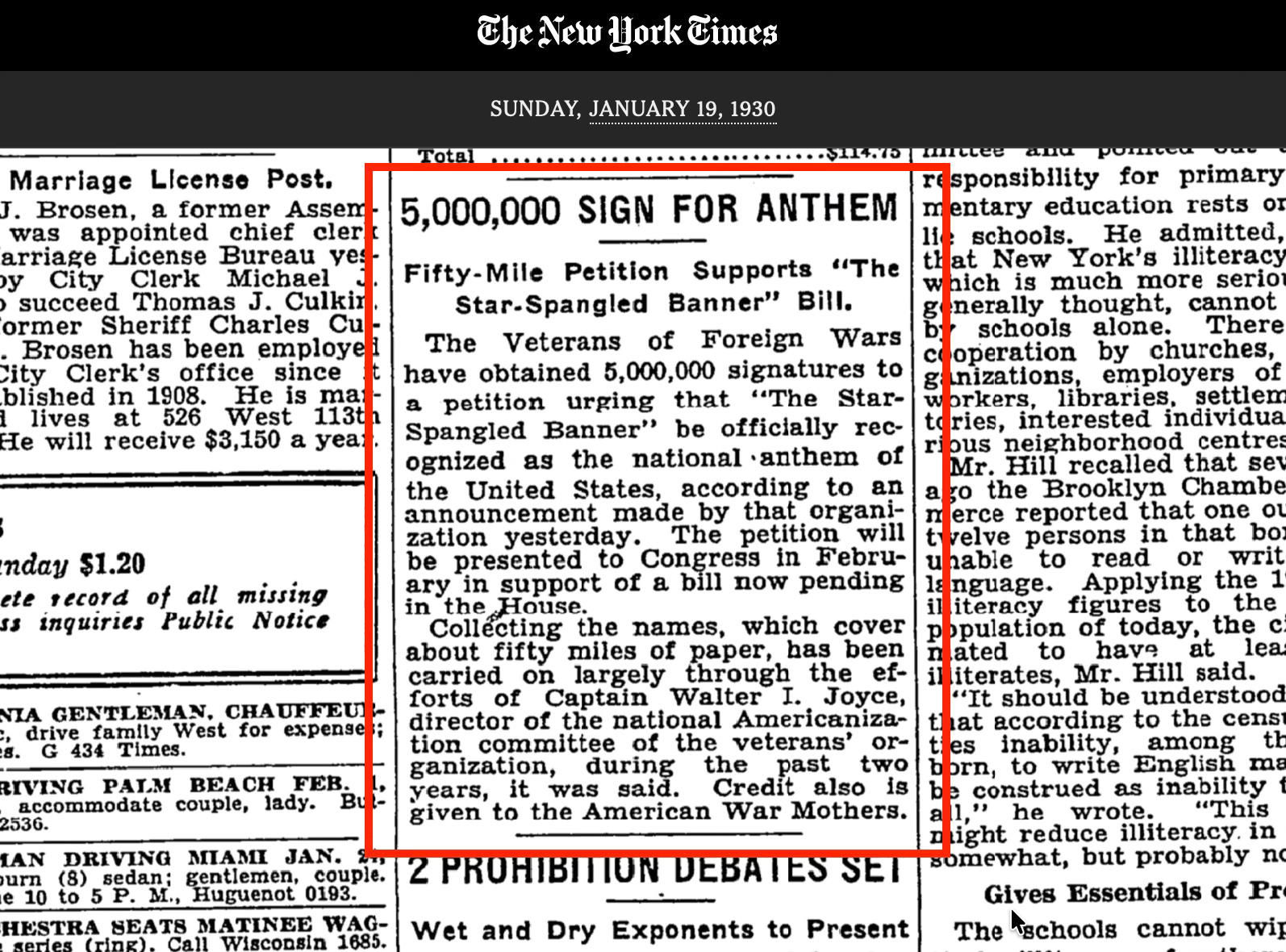
Anyway, I started reading more about how it actually happened. The key advocacy group behind it was the Veterans of Foreign Wars, which claimed they’d gathered five million signatures on petitions supporting the song.
Five million signatures, huh?
On paper, huh?
In the 1930s that would have represented roughly 7% of ALL American adults. It would have been an extraordinary feat even today, with the internet.
Did they actually produce these signatures? Nope.
People at the time pointed out that five million signatures would have created a document many miles long. No one seems to have ever seen it.
Veterans wanted The Star-Spangled Banner over America the Beautiful because the military was already using it.
This was the era of “Americanization,” when organizations like the VFW were pushing for cultural conformity—one country, one flag, one language, one anthem.
Whether they had the signatures or not, they clearly had a movement. But then, being a bit of an amateur student of history, I thought to myself, what else was going on regarding veterans in the early 1930s?
The Bonus Army
Well, for one thing — barely a year after the anthem, tens of thousands of World War I veterans and their families, ravaged by the Depression, marched on Washington asking early payment of bonuses they were entitled to for their service (although not until 1945, under the rules).
These were the men of the Bonus Army, and having made it to Washington with no other place to go, they set up camps on the National Mall and elsewhere, and waited.
Congress said no. President Hoover ordered them cleared out. And on July 28, 1932—sixteen months after Congress gave veterans the anthem they wanted—police shot and killed two veterans, William Hushka and Eric Carlson.
Then the U.S. Army, led by Douglas MacArthur, drove the remaining veterans out of Washington with tear gas, bayonets, and cavalry. A baby died from tear gas exposure.
I swear, I could become a cynic after writing about optimism each week, but such is life:
U.S. to veterans, 1931: Want a song? No problem.
U.S. to veterans, 1932: Want financial help? No way.
We haven’t even gotten to the controversy over the third verse of the anthem, the one that includes the line “No refuge could save the hireling and slave / From the terror of flight, or the gloom of the grave.”
Historians debate what Francis Scott Key meant by that, to put it lightly. In fact, I think it’s right up there with “Louie Louie” and “A Whiter Shade of Pale” in terms of people having yearlong debates over what the heck the lyrics actually mean.
(Not to digress, but the FBI spent 2 years in the 1960s trying to decipher “Louie Louie” for coded messages or obscenity, before concluding the lyrics were “unintelligible at any speed.”)
I still like the song
Look, I’m not advocating we change the national anthem.
At this point, it’s compelling simply because it’s the anthem—because it’s what we’ve always done, because it marks that moment before the game starts.
Plus it was key to a very funny scene in the 1982 Leslie Nielsen movie, The Naked Gun.
Also, I really like the ending line. Who wouldn’t want to live in “the land of the free and the home of the brave?”
But, a story I thought would be about unity turned out to be about a lobbying campaign with possibly fabricated numbers, a Congress that said yes to symbolism and no to survival, and a song written by a slaveholder that we don’t fully sing because parts of it are too uncomfortable.
We’re a country with the word “United” in our name, and we don’t often live up to it. Maybe we never have. The song has grown on us anyway.
Is that optimistic? You decide. But it’s still a pretty good story.
Other things:
Defense Secretary Pete Hegseth: “Yesterday, in the Indian Ocean... an American submarine sunk an Iranian warship that thought it was safe in international waters. Instead, it was sunk by a torpedo. Quiet death. The first sinking of an enemy ship by a torpedo since World War II.” (Military.com)
Even as they voiced misgivings about the U.S.-Israeli war on Iran, some European nations are now deploying their armed forces. Britain and France, neither of which is part of the assault on Iran, announced they would use their navies and air forces to help blunt Iran’s retaliatory strikes. Greece also sent planes and warships to its neighbor, Cyprus. (NYT)
The Pentagon is rapidly burning through its stocks of precision weapons, while also expending sophisticated air defense missiles at a rate that puts the U.S. military potentially “days away” from having to prioritize which targets to intercept, according to three people familiar with the matter. A Pentagon spokesman, Sean Parnell, denied this, saying that the military “has everything it needs to execute any mission at any time and place of the President’s choosing and on any timeline.” (WashPost)
The Justice Department has withheld thousands of documents from the Epstein files, including FBI documents that detailed a woman’s unverified allegations of sexual misconduct against President Trump. After a Wall Street Journal analysis identified more than 40,000 [missing] files, a Justice Department spokeswoman said that “47,635 files were offline for further review and should be ready for re-production by the end of the week ... This is the most transparent Department of Justice in history.” (WSJ)
A woman on probation for stowing away on an international flight has been arrested again after sneaking onto a flight from Newark, New Jersey, to Milan, Italy. Svetlana Dali, convicted in 2024 for flying to Paris without a passport or ticket, was taken into custody Thursday at Milan’s Malpensa Airport. (AP)
5 takeaways from the first primaries of the 2026 midterms. (NPR)
40 Years and 10,000 Broadcasts In, They’re Still Live on Air: Rick Ardon and Susannah Carr have been delivering the news together in Western Australia since 1985 — a Guinness World Record. (NYT)
Thanks for reading. See you in the comments.
Well a link to the full lyrics would be nice. Like most people and I suspect many Americans, I didn't know the rst of the story. These are dark days when the first verse is sounding loudly. It is in the songs complete lyric that a hope for an America truly the land of the free might be obtained. When the rest of the world hears verse one and sees the military adventurism it's an incomplete narrative. And the hockey fans chanting USA USA to an NHL team with less than 30 % Americans. Here's the link https://amhistory.si.edu/starspangledbanner/pdf/ssb_lyrics.pdf
Great follow up story. Well done! If we do not have controversy we would not have the USA! We were "Born to be Wild"!
Chris Vargo