

Merry Christmas! We’re on “low power mode” today — because frankly nobody should be working on Christmas.
Also — last reminder about my last-minute Christmas gift idea: Life Story Magic! Remember to use code UNDERSTANDABLY2025 at checkout and you’ll get the Understandably reader discount. I’ll also include a digital gift card that will go straight to your inbox!
Merry Christmas, Happy Holidays, and Happy New Year!
Hee-Haw and Merry Christmas!
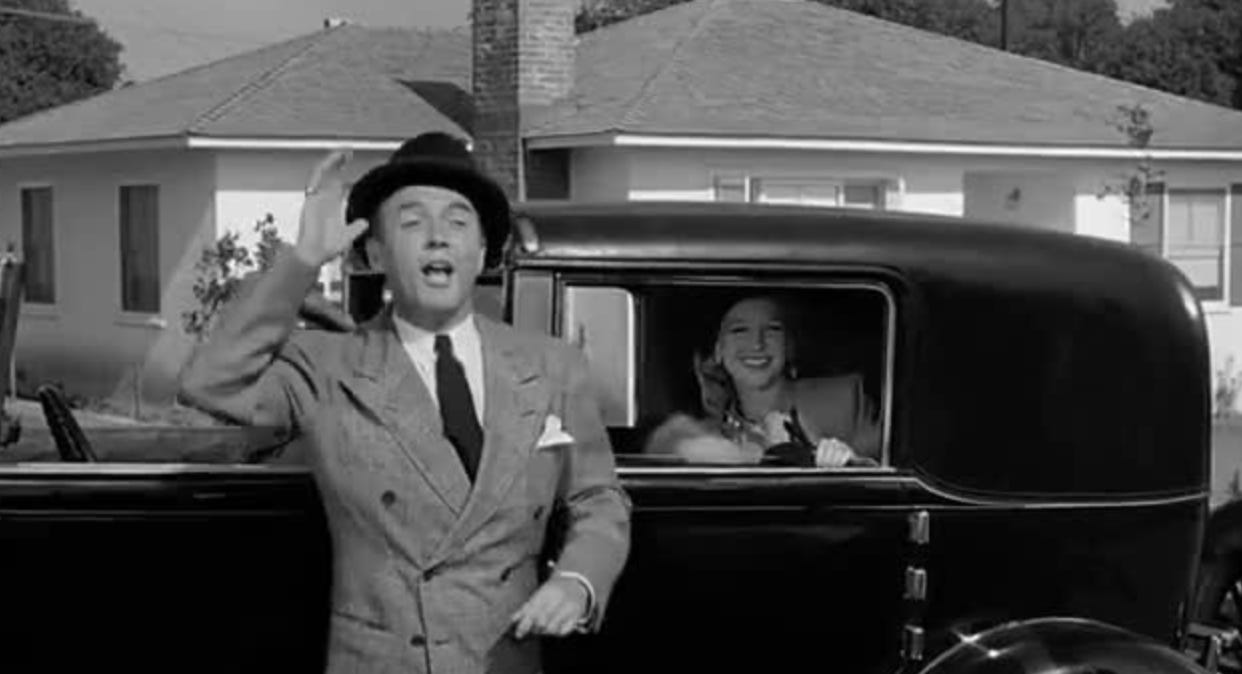
This will mark the second time this month I’ve written about the 1946 movie, It’s a Wonderful Life. I was surprised frankly to hear from so many people who had never seen it—but also from many who love it.
OK, for today’s missive, let’s talk about the key life lesson it contains that most people miss, and that—
Wait, everyone’s seen the movie, right? OK, in case not, here’s It’s a Wonderful Life in just over 100 words. (Then, why.):
Frank Capra directed; Jimmy Stewart stars as George Bailey: husband, father, and president of a tiny community bank in Bedford Falls, USA.
Bailey has always had ambition and wanderlust, but he got stuck in his tiny hometown.
In December 1945, he’s $8,000 short at work, through zero fault of his own, just as the bank examiners arrive.
Total calamity. He contemplates suicide, thinks better, but wishes he’d never been born.
People pray, God hears, sends an angel. George gets to see what others’ lives would have been like without him: he’s had incredible influences he never knew about.
Spoiler alert (on a 74-year-old movie): He learns to be grateful.
Meanwhile, folks in his town learn about his troubles, chip in $5 here, $10 there, and make up the $8,000.
Classic Christmas movie. Right up there with Miracle on 34th Street and Die Hard. It has a hit-you-over-the-head moral, which is basically that you never really know how important you are to other people.
Also, to cite an oft-quoted line, “No man is a failure who has friends."
Which brings us to why I’m discussing it, besides the the calendar. It’s because of a fairly minor character in the movie named Sam Wainwright, who only gets seven lines. (I downloaded the screenplay and counted.)
He’s one of George’s childhood friends—but he made it out of town, started a company, and grew rich. He often shows up over the years to try to do things for George, but George always puts his community ahead of his own ambition.
Sam also has an odd, annoying verbal habit: He uses the [word (?)/phrase (?)] “hee-haw,” as kind of an idiosyncratic interjection.
Maybe it was less weird in the 1940s.
He’s not even in the climactic scene of the movie. But, he sends a telegram that’s read in front of the group, as they’re throwing their coins and dollars and $5s into the pot to make up George’s shortfall. Here’s that part of the script:
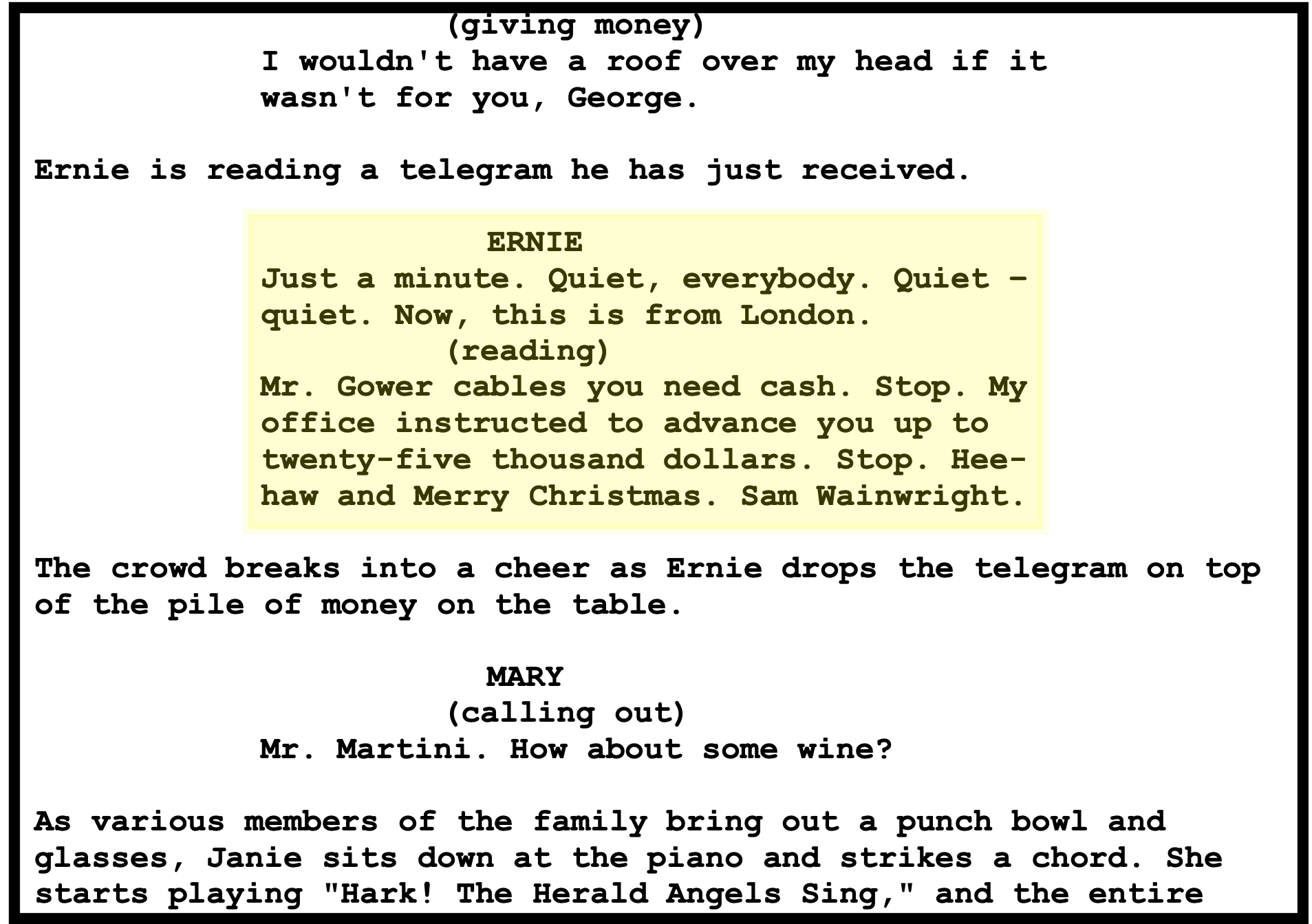
Good friend, right? By my math, $25,000 in 1945 is worth about $450,000 today. Without even knowing any of the details, he’s willing to step up for George like this.
t’s always struck me that Sam’s telegram very nearly becomes a deus ex machina. Very little of the rest of the story—the shortfall, George’s distress and dark thoughts, God sending an angel, all the neighbors digging deep—really had to happen in order to reach the same result at the end.
All that did have to happen is that George would have had to swallow his pride, tell his friend he needed help, and be willing to accept it.
Of course, then there’d be no story, and I’d be stuck watching some really bad, mail-it-in Christmas movie starring Tim Allen or Vince Vaughn, with my wife and daughter on movie night.
Anyway, the real moral? Cut to the chase, quit the drama if you can, and ask for help. There’s often someone out there, eager to offer assistance, in a position to do so.
Oh, and even better, be the person who says “hee-haw” for somebody else.
I wanted to let you know that I watched “It’s a Wonderful Life” after your first post as I was impressed by the fact that acting in it turned Jimmy Stewart around in his real life. I wanted to know the story that did that. I had never watched the movie before. I liked the movie for its moral story, not from its Christmas theme as I do not celebrate Christmas. And really, because the story took place right before Christmas has no bearing on the theme of the movie. It could have been an anytime of year. Thanks for bringing us stories like you do!
My superpower is asking for help.