

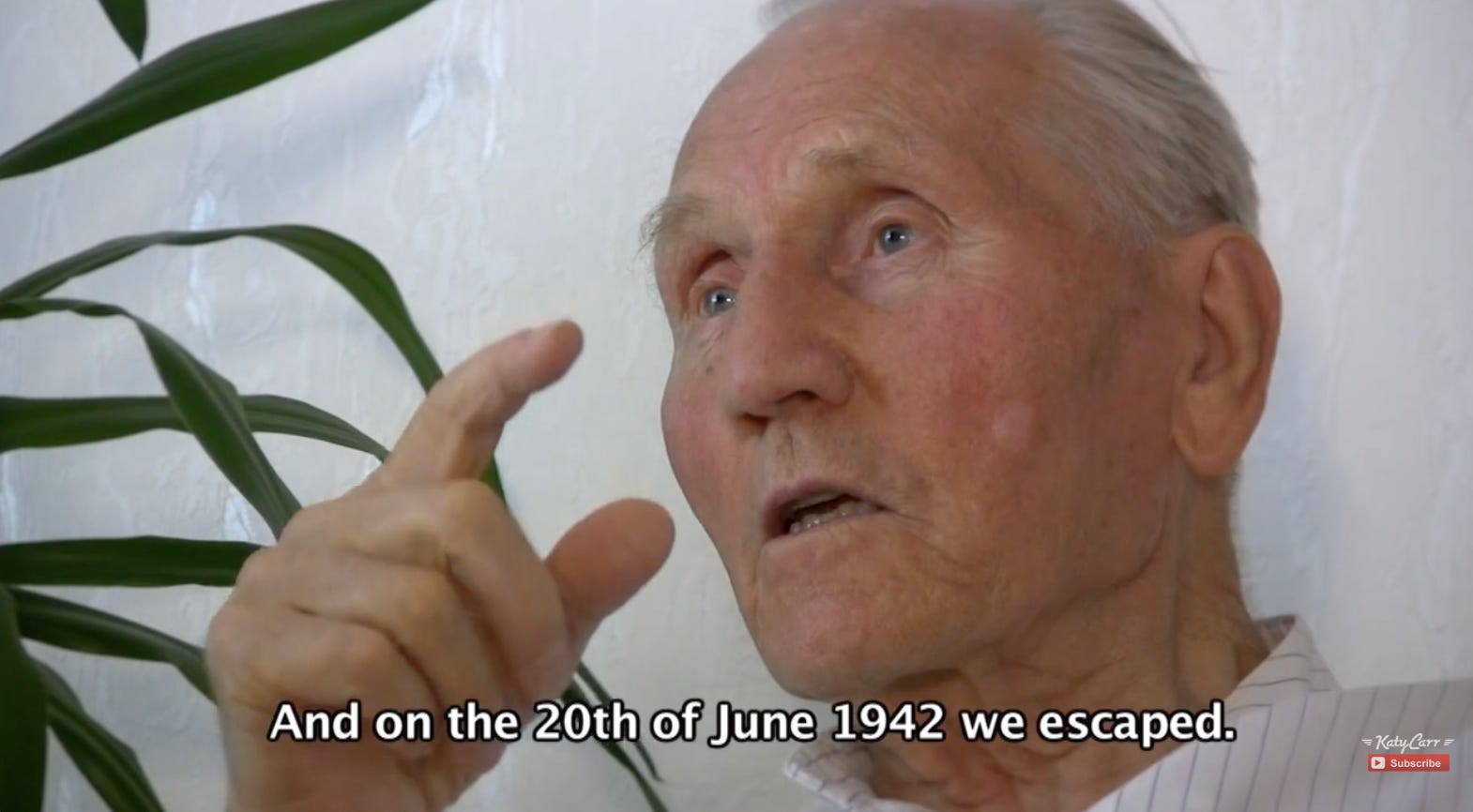
This week’s essay opens in one of the most horrible places in the history of the world, and with a short story that two groups of people experienced very differently at the time.
The first group is very hard to have any empathy for: a group of SS guards at the main gate at Auschwitz on June 20, 1942.
Whoever they were, they were nervous and afraid: One of them looked up to see the car belonging to camp commandant Rudolf Höss idling in front of him, waiting for them to open the barrier.
An officer inside — an Untersturmführer according to his rank insignia, roughly equivalent to a lieutenant — leaned out the window and screamed at them: “Wake up, you buggers! Open up or I’ll open you up!”
The guards, rattled, scrambled to raise the barrier. The car drove through.
The second group of people? The men inside the car.
They were not in fact Nazi officers; they were four Auschwitz prisoners in the midst of one of the most daring escapes you’ll ever learn about. Their names:
Kazik Piechowski, 22, who had been an Eagle Scout imprisoned at Auschwitz for two years. (Boy Scouts were targeted early on; apparently the Nazis feared them as young men with strong feelings of patriotism).
a Polish priest named Józef Lempart.
a young resistance courier named Stanisław Jaster.
Eugeniusz Bendera, a mechanic who worked in the camp’s motor pool repairing SS vehicles, who had been placed on a list for execution — spurring the escape plan to begin with.
They had stolen the car, the uniforms, and Nazi guns and hand grenades, but they had pledged that they would not kill any Germans on the way out—out of hard-earned confidence that no matter what they might do to hurt the Nazis, the Nazis would enact far greater vengeance on their fellow prisoners.
It was Piechowski who spoke German, and who wore the lieutenant’s uniform, and who yelled at the gate guards. Had they not complied, all four men had decided to shoot each other rather than risk recapture and retribution.
Exactly 2 years
Auschwitz was the largest Nazi killing center. Of roughly 1.3 million people sent there, an estimated 1.1 million died — most of them Jews, but also Poles, Roma, and Soviet prisoners of war.
Piechowski had arrived two years before, to the day, in the second transport ever sent to the camp, when it was still being built by the people imprisoned in it, after being caught trying to escape to Hungary.
He later described the first months as a kind of total shock — the starvation, the violence, prisoners forced to eat from the same bowl they used at night if they lost their spoon.
Their escape plan took almost absurd levels of nerve.
They disguised themselves as a work detail moving a cart, which gave them relative uninspected mobility in the camp. Then, they managed to sneak into a storeroom via a coal chute Piechowski had rigged so that it didn’t latch properly, and stole the Nazi uniforms, weapons — and Höss’s Steyr 220.
Besides simply escaping, they carried an intelligence report written by Witold Pilecki — a Polish army officer who had deliberately gotten himself arrested and sent to Auschwitz to organize resistance and smuggle information to the Polish underground.
Not over for a long time afterward
The barrier went up. They drove out of Auschwitz in the commandant’s car, in German uniforms, carrying German weapons, and nobody stopped them.
Forty miles away, they abandoned the car and split up. All four men survived the escape itself, although the German reprisals were in fact brutal.
Both Piechowski’s parents and Jaster’s were arrested by the Germans afterward and died at Auschwitz.
According to multiple accounts, the camp’s policy of tattooing prisoners with identification numbers — the practice most associated with Auschwitz today — was introduced partly in response to this escape, after a furious Höss demanded to know how four prisoners could vanish in his own car, wearing his own men’s uniforms, carrying his own ammunition.
Piechowski made his way toward Ukraine, couldn’t find safe refuge there, returned to Poland under a false name, and joined the Home Army — the main Polish underground resistance — fighting the Germans until the war ended in 1945.
Then, under the new Communist government that took power in Poland after the war, he was arrested again. Membership in the Home Army — the same resistance movement that had fought the Nazis — was now treated as evidence of disloyalty to the new regime. Piechowski was sentenced to ten years in prison.
He served seven.
Witold Pilecki
Honestly, Witold Pilecki deserves his own newsletter and then some; in short, he escaped Auschwitz himself in 1943, fought in the Warsaw Uprising in 1944, spent the rest of the war as a prisoner of the Germans, and then — like Piechowski — returned to Poland afterward.
He was arrested by the Communist secret police in 1947, accused of espionage, and executed in May 1948.
As for Piechowski, he lived to be 98. After Poland’s transition away from communism, he was awarded the Order of the White Eagle, the country’s highest civilian honor. For most of his life before that, almost nobody outside Poland had heard his story.
The optimism in this story isn’t that they escaped — most people who tried didn’t, and the four of them knew the odds better than anyone. It’s that faced with those odds, knowing exactly what failure would cost, they decided to try anyway. Sometimes fortune favors the bold.
Sometimes the boldness is the whole point, regardless of what fortune does.
Katy Carr
In 2009, a British singer-songwriter named Katy Carr — who has Polish roots on her mother’s side — learned about Piechowski’s escape and was struck by the details of the last 80 meters or so, the moment at the gate, the few seconds when the entire plan came down to whether four starving men in stolen uniforms could bluff their way past a single guard.
She wrote a song about it, called “Kommander’s Car,” and then traveled to Gdansk to meet Piechowski in person and play it for him. He had never had anyone do anything like that before, and Carr later made a documentary about the meeting and spent years afterward touring with the song and working to keep the story alive.
I met Katy Carr briefly years ago, when I was a reporter at Stars and Stripes, which is how I first heard about Piechowski’s story.
It wasn’t really a Stripes story, and I couldn’t write about it then. But I’m sure glad I knew it to share now.
I’ll admit I went back and forth on whether to write about something as terrible and sacred as Auschwitz in a newsletter that’s supposed to be about optimism. I’m not sure any of us is fully worthy of telling these stories.
But I think they’re worth knowing, and worth retelling, and so here we are.
7 optimistic moments from history this week
June 14: “We’ve had a terrible voyage. The wonder is we are here at all.” — Captain John Alcock,upon landing in a bog outside Clifden, Ireland, on June 15, 1919, after departing Newfoundland the previous afternoon with navigator Arthur Whitten Brown — completing the first nonstop transatlantic flight in history.
June 15: “No freeman shall be taken or imprisoned, or disseised, or outlawed, or exiled, or in any way destroyed... except by the lawful judgment of his peers.” — From the Magna Carta, sealed by King John at Runnymede on this day in 1215, under pressure from rebel barons who had seized London.
June 16: “Hey sky, take off your hat, I’m on my way!” — Valentina Tereshkova, a 26-year-old former textile factory worker, as she launched aboard Vostok 6 on this day in 1963, becoming the first woman in space. She orbited the Earth 48 times over nearly three days.
June 17: “I was just baggage, like a sack of potatoes.” — Amelia Earhart, describing her role as a passenger and logkeeper, aboard the Fokker trimotor Friendship, which on this day in 1928 became the first aircraft to carry a woman across the Atlantic. Earhart was embarrassed, since the flight made her famous, but she’d done none of the flying herself. Four years later, in 1932, she went back and did it solo.
June 18: “I knew that women belonged there.” — Sally Ride, who on this day in 1983 became the first American woman in space, launching aboard the Space Shuttle Challenger as a mission specialist.
June 19: “The people of Texas are informed that, in accordance with a proclamation from the Executive of the United States, all slaves are free.” — General Order No. 3, read aloud by Union Major General Gordon Granger and his troops on this day in 1865 — more than two years after the Emancipation Proclamation, and more than two months after the Confederacy’s surrender.
June 20: "This age of fast-moving events requires quick, dependable communications for use in time of emergency." — President John F. Kennedy, on this day in 1963, the day American and Soviet negotiators signed the agreement creating the Washington-Moscow hotline. The first message was a typing test: The quick brown fox jumped over the lazy dog's back 1234567890.
It is a story worth knowing - if only to shield us against such inhumanity
Bravo! Well done! We all need to hear stories of courage; we may need them someday!