

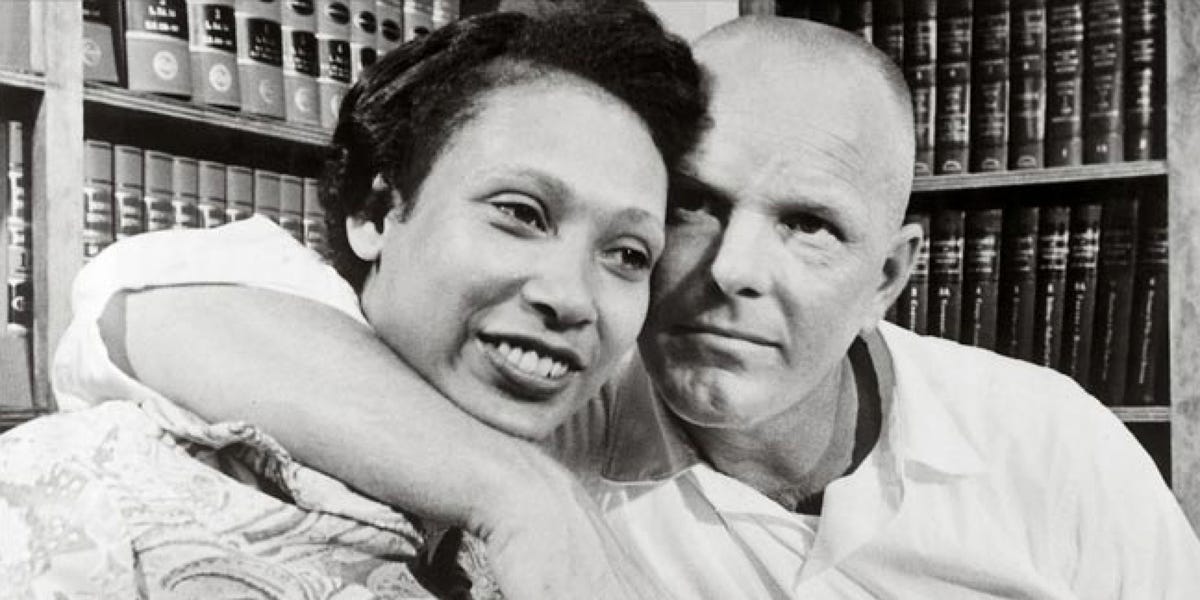
Little diddy ‘bout Richard and Mildred …
With apologies to John Mellencamp, it’s time we talked about Richard Perry Loving and Mildred Delores Jeter if you don’t know who they are—and why we should know them.
Richard Perry Loving was born on October 29, 1933, in Central Point, Virginia, a small farming community in Caroline County. His family was of English and Irish descent. He was a bricklayer and construction worker, quiet and taciturn, with a platinum blonde crew cut.
A man of few words.
Mildred Delores Jeter was born on June 22, 1939, in the same community. Her ancestry was African American and Native American — she identified primarily as Rappahannock — and she was shy, soft-spoken, and possessed of what people who knew her described as a quiet dignity.
She and Richard grew up as neighbors. He first came to her family’s house as a teenager to hear her siblings play music.
Central Point was, at that time — and despite Virginia’s segregation laws — a surprisingly integrated community in practice — mixed-race families had lived there for generations, and the formal rules of Jim Crow sat uneasily alongside the actual texture of daily life.
Richard and Mildred knew each other for years before they began dating, and — we’re all adults here — when they got pregnant, they decided to get married.
Only problem: mixed race marriages weren’t allowed in Virginia, so they drove to Washington D.C. — where it was legal — on June 2, 1958.
Then, they came home to Virginia and moved in with Mildred’s family. Five weeks later, 2 a.m. on July 14, 1958, Sheriff Garnett Brooks and two deputies burst into their bedroom.
The charge was violating Virginia’s Racial Integrity Act of 1924, which made interracial marriage a felony. On the wall above the bed was their marriage certificate from Washington D.C.; Sheriff Brooks told Richard it was no good in Virginia.
They pleaded guilty. Judge Leon Bazile sentenced them to one year in prison, then suspended the sentence on the condition that they leave Virginia and not return together for 25 years. His Honor wrote:
“Almighty God created the races white, black, yellow, malay and red, and he placed them on separate continents.
The fact that he separated the races shows that he did not intend for the races to mix.”
The Lovings moved to Washington D.C. They hated it. Their whole world was in Caroline County — their families, their friends, the land Richard knew.
Mildred later said that Washington felt like a foreign country. So, they’d sneak back to Virginia, taking risks whenever they could, for family events, for the births of their children — Richard’s mother was a midwife and delivered the babies at home.
Police kept finding them and expelling them again. Caroline County is about 70 miles from Washington — just across a border they couldn’t cross.
In 1963, Mildred wrote a letter to Attorney General Robert F. Kennedy, asking for help. Kennedy referred her to the ACLU.
Two lawyers, Bernard Cohen and Philip Hirschbaum, took the case for free. It wound its way through the Virginia courts, and eventually to the Supreme Court.
Neither Richard nor Mildred attended the oral arguments. Richard sent a message to his lawyers:
“Tell the Court I love my wife and it is just not fair that I cannot live with her in Virginia.”
On June 12, 1967 — 58 years ago this week — the Supreme Court ruled unanimously in their favor.
Chief Justice Earl Warren wrote the opinion:
“The freedom to marry has long been recognized as one of the vital personal rights essential to the orderly pursuit of happiness by free men.”
Virginia’s Racial Integrity Act was struck down, and laws banning interracial marriage in 15 other states fell with it.
The Lovings moved back home to Caroline County, where Richard built them a small concrete block house. They lived quietly, mostly out of the public eye, the way they had always wanted.
Richard was killed by a drunk driver in 1975; Mildred lost her right eye in the same accident. In a rare interview in 2007, she said:
“I am proud that Richard’s and my name is on a court case that can help reinforce the love, the commitment, the fairness, and the family that so many people, black or white, young or old, gay or straight seek in life.”
Mildred never remarried, and she stayed in the house Richard built until she died of pneumonia the following year.
There was a film about the Lovings released in 2016 — simply called Loving, starring Ruth Negga and Joel Edgerton — that told the story well if you want more.
Honestly, could you pick a better name? Loving v. Virginia.
Quick personal note: In 1998, I spoke briefly with Mildred Loving.
I’d been thinking about writing a book about the real people behind landmark Supreme Court cases — a way to reiterate that our common law system is built on real human beings with real lives that are sometimes turned upside down in the process of making history.
I remember her as a quiet, dignified, composed woman who was a bit skeptical but very comfortable with her story and her place in history.
I set the book project aside; life intervened.
But I’m glad I get to tell the story now.
7 optimistic moments from history this week
June 7: “Only by playing with something can you find out what it is and what it can do.” — Godtfred Kirk Christiansen, managing director of the Lego Group, who on this day in 1968 opened the first Legoland park in Billund, Denmark. The park was built to accommodate the crowds of people who kept showing up at the factory wanting to see Lego models.
June 8: “If liberty means anything at all, it means the right to tell people what they do not want to hear.” — George Orwell, whose final novel, 1984, was published on this day in 1949.
June 9: “Actually, I wanted to be a doctor; but instead I became the biggest quack in the world.” — Clarence “Ducky” Nash, the voice of Donald Duck, recalling his unlikely career — which began on this day in 1934 when the animated short The Wise Little Hen introduced Donald to the world.
June 10: “He was the first living human with whom I had ever talked who knew what he was talking about in regard to alcoholism from actual experience. In other words, he talked my language.” — Bill Wilson, co-founder of Alcoholics Anonymous, describing his first conversation with Dr. Bob Smith, who on this day in 1935 took his last drink..
June 11: “There will come a day in your life when you must act for others — your family, perhaps your community — and you must be ready.” — Vivian Malone Jones, speaking at the University of Alabama’s commencement ceremony in 2000, 37 years after she and James Hood became the first Black students to enroll there on this day in 1963.
June 12: “Mr. Gorbachev, open this gate. Mr. Gorbachev, tear down this wall.” — Ronald Reagan, standing 100 yards from the Berlin Wall at the Brandenburg Gate in West Berlin on this day in 1987.
June 13: “Prior to any questioning, the person must be warned that he has a right to remain silent, that any statement he does make may be used as evidence against him, and that he has a right to the presence of an attorney, either retained or appointed.” — Chief Justice Earl Warren, from the majority opinion in Miranda v. Arizona, decided on this day in 1966.
Kinda interesting that a mere 2 years after the Supreme Court’s decision Virginia adopted “Virginia is for Lovers”.
Yes, thanks for the story, Bill - heart warming in the end and hopeful. Actually, all of the stories were. Nice way to start the week. Thanks again!