
In May 1999, I was sitting in the Wang Theatre in Boston watching my sister graduate from Emerson College. Ted Leonsis was the commencement speaker. At that moment, he was a top early executive at AOL and the new owner of the Washington Capitals and Wizards.
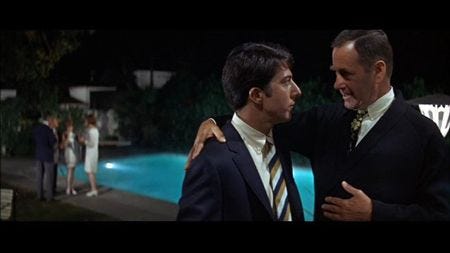
Leonsis had one word for the graduating class: “internet.” He said it repeatedly, riffing on the famous “plastics” scene from The Graduate:
Want to start a business? “I’ve got a word for you: internet.”
Want to be an artist or a writer or a musician? “internet.”
Want to find meaning and purpose and change people’s lives? “I have just one word for you: internet.”
He talked about e-commerce and music being downloaded rather than pressed onto CDs. Also, he introduced the concept of “viral marketing” before most people in the room had heard the term.
As best I can remember it, the response was mostly polite but a lot of it didn’t really land. There were definitely some jeers.
I was a few years older than most of the graduates, already dabbling in early internet projects on the side while working a full-time day job. I remember thinking, “This guy is spinning gold, and I don’t think the people around me feel it.”
“No disrespect …”
When Leonsis finished, the other honorary degree recipients took their turns.
Alice Hoffman, the novelist, kept it brief but got a massive applause line: “I mean, no disrespect to the internet, but I’m here to speak very briefly on behalf of books.”
Morley Safer of CBS News went further, gesturing directly back at Leonsis on the stage behind him:
I caution you, in spite of what the maestro here said, do not let technology become your master.
Do not be seduced by the siren song of information on call. Much of it is bogus.
For all of its billions of facts on file, it can also be a dank and dark breeding ground for the vicious and mean spirited. It is the new home of the big lie.
Big applause.
Leonsis had a sense of humor. As he returned to the podium to receive his honorary degree, he took the microphone for one last coda: “I’d like to thank the Friars for hosting this roast.”
Flash forward
Why bring up this 27-year-old commencement speech? Three reasons:
Last month, at the University of Central Florida, a real estate executive named Gloria Caulfield told a room full of arts and humanities graduates that the rise of artificial intelligence is “the next industrial revolution.” The crowd erupted in boos. Someone yelled, “AI sucks!” She turned to the other speakers onstage: “What happened? OK, I struck a chord.”
A week later, at the University of Arizona, former Google CEO Eric Schmidt was booed multiple times while discussing AI — booing that began, by some accounts, before he even reached the lectern. He tried to acknowledge the crowd’s anxiety directly: “There is a fear in your generation that the future has already been written, that the machines are coming, and that the jobs are evaporating.” They booed that, too.
At Emory University, Delta CEO Ed Bastian told graduates he had tried using AI to write his commencement address, and it was quick and easy, but it lacked soul and warmth — so he threw it out and rewrote it with pencil and paper. “You want to hear from me,” he told the graduates to applause, “not some algorithm of me.”
Right, but also right
This is not an article where I’m going to say that the example from 1999 proves AI is the future and anyone who objects is a Luddite who will be left behind.
I mean, Leonsis was clearly right, but Safer was mostly on target too.
The internet has created zillions of jobs, revolutionized industries, and changed the world. It has also become a breeding ground for the vicious and mean-spirited.
History doesn’t repeat itself, but it rhymes. If I were sitting in one of those red robes right now, I think I’d be paying very close attention to AI — with both enthusiasm and caution.
I’d hope my attitude would be one of skepticism, but not cynicism, which, come to think of it, is what I learned during my own college education from the Jesuits.
But that’s another graduation. I wrote about that one here.
Other things worth knowing …
CNBC: The Department of Justice has permanently abandoned plans for a $1.8 billion fund created to settle a lawsuit by President Donald Trump against the IRS, Acting Attorney General Todd Blanche, who was previously Trump’s criminal defense attorney, testified Tuesday. But the other part of the settlement — protecting Trump, his family members, and related business entities remain protected from any tax audits and enforcement actions — remains in effect.
NPR — A divided D.C. Circuit Court of Appeals ruled 2-1 that the Trump administration's transgender military ban is unconstitutional, finding the policy was rooted in animus toward a politically unpopular group rather than military necessity. Defense Secretary Pete Hegseth’s reply: "See you at SCOTUS."
TechCrunch — Anthropic, the AI company behind Claude, filed confidentially with the SEC for an IPO, jumping ahead of rival OpenAI in what is shaping up to be a landmark public market debut. The filing comes days after a $65 billion Series H pushed Anthropic's valuation to roughly $965 billion.
CNBC, Washington Post — President Trump tapped Bill Pulte, who leads the Federal Housing Finance Agency and who has served as an attack dog against Trump’s foes, to serve as acting director of national intelligence. Pulte has no known prior intelligence experience. Separately: a pardoned Jan. 6 rioter, Elias Irizarry, has been hired to work inside a Pentagon office that manages highly classified military operations.
Bloomberg — More than 1,000 current and former SpaceX employees have banded together to negotiate with wealth management firms for better pricing and access to sophisticated tax-saving financial products ahead of an IPO that is set to turn many of them into multi-millionaires. Employees in line for IPO windfalls typically seek out their own wealth advisers. The SpaceX group’s push for a kind of collective bargaining has the potential to create a new playbook for startup employees.
NPR — Former New York congressman George Santos is being investigated over his trading activity on the prediction market site Kalshi. In February, four months after being released from federal prison, Santos posted a video to X saying he would attend Trump's State of the Union address — sending odds on Kalshi soaring. But he didn't show up. What Santos didn't say was that he had already placed bets on Kalshi that he was not going to appear, and made tens of thousands of dollars as a result.
The Guardian — ‘Like a Klingon prison’: inside Barack Obama’s audacious, near-windowless, $850m presidential library.
Thanks for reading. I wrote about some of this at Inc.com. See you in the comments.
"Every great movement must experience three stages: ridicule, discussion, adoption"
- John Stuart Mill (English exponent of Utilitarianism, ethical theorist, Philosopher, Economist and Logician)
It was quite interesting to read the commencement speeches from ‘99. The internet was the great disrupter but the iPhone bumped the impact exponentially.
Thanks for an another cool story.
I'm getting tired of coming to the comments. It used to be about connecting to the stories that Bill posts. Now it's turning into Instagram. Show some respect for each other and stop always thinking you're the only right person in the room. This place should be an escape from that crap.