
Friends, I’ve been traveling for spring break. I’m back — but have you ever come back from a vacation and felt like you needed a vacation to recover from vacation? Yeah, that.
Fortunately, the entire U.S. government has been planning for this for me, by arranging last week to have had Artemis II blast off last week and travel around the moon. That makes it the perfect time to visit one of the last times we did this — before I was even born — and what it spawned. Truly, I’m glad to have this chance. See you below.
In the summer of 1966, a man named Stewart Brand—a Stanford graduate, former soldier, and self-described “loafing artist“—set off on a quest.
The Space Race was nearly a decade old, and Brand had been seized with the realization that NASA had yet to release a photograph of the whole Earth taken from space.
He started a public campaign, and hitchhiked across the country promoting it.
Soon enough, NASA did in fact release the first such “whole Earth photo,” taken at the end of 1967, from a satellite called ATS-3. And, Brand was inspired to it on the cover of an idiosyncratic new magazine he started, called the Whole Earth Catalog.
What was the Whole Earth Catalog? Well, it could best be described as—actually, let’s let the late Steve Jobs explain it, as he did in his iconic speech at Stanford University in 2005:
When I was young, there was an amazing publication called The Whole Earth Catalog, which was one of the bibles of my generation. It was created by a fellow named Stewart Brand not far from here in Menlo Park, and he brought it to life with his poetic touch.
...
It was sort of like Google in paperback form, 35 years before Google came along: It was idealistic, and overflowing with neat tools and great notions.
Brand only printed 1,000 copies of that first issue, but later issues took off, with more than 2 million copies. And, Jobs wasn’t just citing him and his work out of the air.
“No one was more influenced, or inspired by, Brand, than the founder of Apple,” writes Carole Cadwalladr. “And while many credit Jobs with being one of the most creative agents of change in the late 20th century, Jobs credited Brand.”
But wait, as the old TV commercial used to say. There’s more.
Fast forward to 1994, when Jeff Bezos and MacKenzie Scott headed to Seattle to launch Amazon. Bezos hired his very first employee: Shel Kaphan, whom he later called, “the most important person ever in the history of Amazon.com.”
What had been Kaphan’s very first job back in 1968?
Working for Brand as one of the original people on The Whole Earth Catalog. As Brad Stone writes in The Everything Store:
Kaphan (by now shorn of his long locks and beard, balding, and in his early forties) was inspired by what he saw as Amazon’s potential to use the Web to fulfill the vision of The Whole Earth Catalog and make information and tools available around the world.
Later, Kaphan introduced Brand to Bezos, which sparked a relationship that led, among other things, to Bezos’s thematically similar $42 million, “Clock of the Long Now,” designed to keep time for 10,000 years. As Brand explained:
Ideally, [the clock] would do for thinking about time what the photographs of Earth from space have done for thinking about the environment. Such icons reframe the way people think.
It’s probably fair to say that the 1967 photo that inspired Brand has since been supplanted in our culture by the Earthrise photo, taken in 1968 by the crew of Apollo 8, and the Blue Marble photo, taken in 1972 by the crew of Apollo 17.
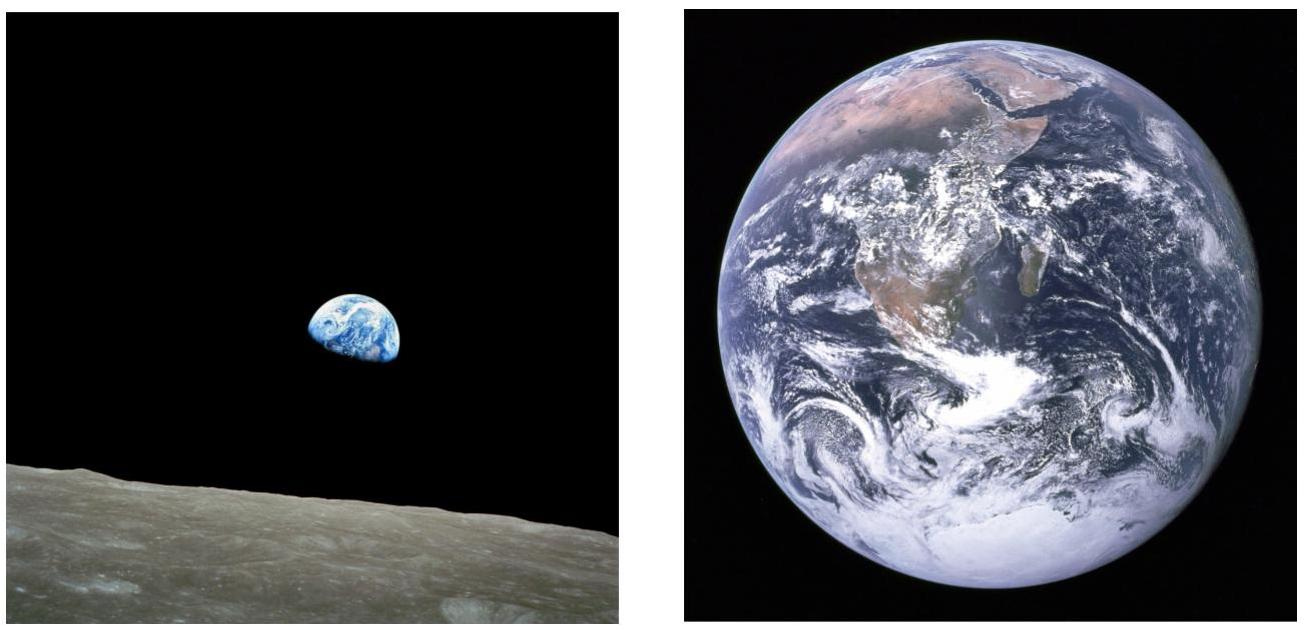
But it was the earlier photo that inspired Brand, and it was Brand who created the catalog and put it on the cover, and the combination was still coming up in the founding stories of two of the world’s biggest companies, 40 and 50 years later.
By the way, in 1966, when Brand set off on his quest to get NASA to release a photo like the ATS-3 one, Steve Jobs was 12. Jeff Bezos was 3.
Something to think about, as we begin the quest to return to the moon, and beyond. There’s no telling what images we’ll create, and who might be inspired by them.
Other things worth knowing …
NASA’s Artemis II crew — Reid Wiseman, Victor Glover, Christina Koch, and Jeremy Hansen — yesterday surpassed the record for the farthest distance any humans have ever traveled from Earth, reaching 252,760 miles, breaking the mark set by Apollo 13 in 1970. They are now beginning their return home. (NASA)
The U.S. pulled off a daring rescue of two aviators shot down over Iran, with one crew member hiding in a mountain crevice after climbing 7,000 feet despite being injured, while the CIA launched a deception campaign to buy time. Two Black Hawk helicopters came under fire and two transport planes had to be blown up during the operation. (AP)
Savannah Guthrie returned to TODAY on Monday for the first time since January 30, one day before her 84-year-old mother Nancy disappeared from her home outside Tucson and authorities said they believe she was taken against her will. “I don’t know how to come back, but I don’t know how not to,” Savannah had said. (TODAY)
The Associated Press is offering buyouts to an unspecified number of U.S. journalists as it pivots away from newspaper journalism — once the lion’s share of its revenue, big newspaper companies now account for just 10% of its income. AP has seen 200% growth in revenue from technology companies over the last four years. (AP)
A new study from the Radiological Society of North America found that when radiologists were given no warning, they correctly identified AI-generated fake X-rays only 41% of the time — and even after being warned fakes were present, their success rate only climbed to 75%. “This creates a high-stakes vulnerability for fraudulent litigation if a fabricated fracture could be indistinguishable from a real one,” the lead author warned. (Fast Company)
South Korea is distributing AI-powered dolls to tens of thousands of elderly people living alone, with sensors that monitor for 24 hours of inactivity and microphones that record daily health check-ins for social workers to review. One caregiver noted that the elderly “don’t tell caregivers or their children some things, but they will tell Hyodol.” (36Kr)
A content creator named Dallas Little has gamed iTunes using an entirely AI-generated singer called “Eddie Dalton” — who does not exist — landing 11 spots on the iTunes top 100 singles chart and the number 3 album, despite only having sold 6,900 tracks total. “There’s no recording time or musical process involved,” the reporter notes. “He’s typing prompts and pushing buttons.” (Showbiz411)
What an amazing inspirational post about our world … and then I read this:
https://heathercoxrichardson.substack.com/p/april-6-2026-monday?utm_campaign=post-expanded-share&utm_medium=web
Trump seems to require an outcome in Iran that will allow him to credibly claim success. Is that even possible given Iran's strong resistance to Trump's demands?
David Ignatius:
My thought on this very difficult question: To resume as a global leader that can achieve a favorable outcome on Iran, Trump must recover badly damaged trust and credibility. His profanity-laden gangster talk has really begun to grate with global leaders. The way to restore credibility is to act responsibly and patiently to reopen the Strait of Hormuz through a combination of diplomacy and military power. "Bombing Iran back into the stone age," among things, would guarantee that the strait will remain an unstable choke point indefniitely. In general, Trump need to act like a mature and responsible president.
— Washington Post