
Argentina beat England yesterday, so they’ll face Spain in the World Cup Final on Sunday.
Here’s a copy and paste from a post-game group chat with some of my college friends.
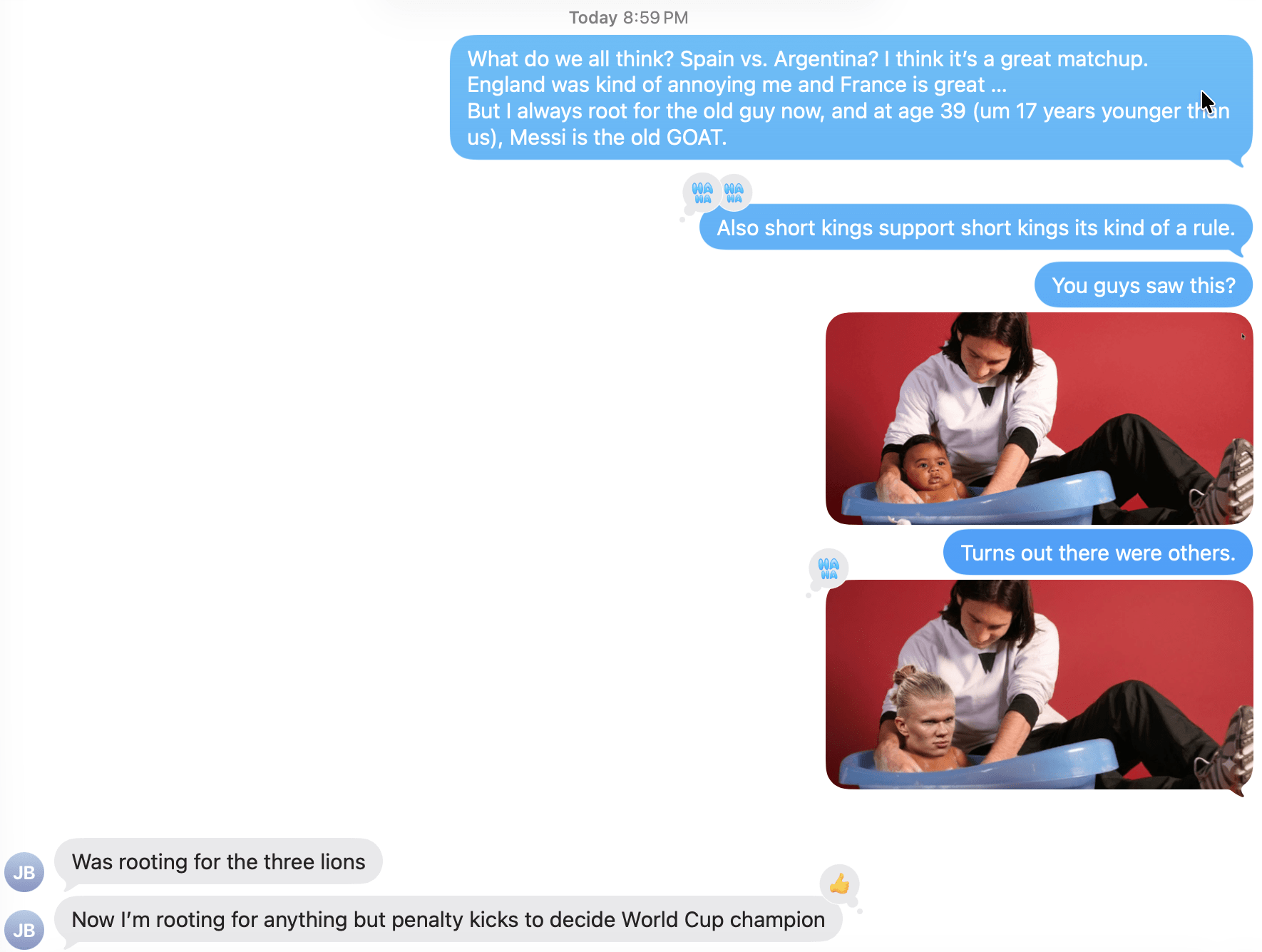
Yes, I am very clever when it comes to making up AI-assisted parodies of World Cup memes (link below in case you don’t know that one).
But as one of those friends from way back when put it, Sunday’s game will be a great one—as long as we don’t wind up tied, and going to penalty kicks.
Look, for those readers for whom “Bill is Very Into the World Cup” has been your least favorite stretch of Understandably newsletters, the good news is that win/lose/draw, it will all be over on Sunday.
But while I’ve got this thin thread of relevance on which to hang for another 80 hours or so, please bear with me. Because penalties are a thing — in more ways than one.
To start with, they come up a lot in soccer.
For those who remember and care enough about what happened in the last World Cup in 2022 — sure enough, Argentina and France were tied after an utterly amazing game, 3 to 3. Then, Argentina won on penalty kicks (4 to 2).
During the knockout stage of this year’s World Cup, we’ve had four games to go penalties already. I was there for one of them (alongside the lovely and talented Mrs. Murphy Jr.); Paraguay tied Germany during regular time and then beat them on penalties.
Then after an epic trip home from Foxboro, what did I do? Stayed up to watch Morocco beat Netherlands, in another game that went to penalties. There was also Argentina coming back to beat Egypt 4-2 on penalties (controversial), and Switzerland beating Colombia 4-3 on penalties (irrelevant now, but still).
Anyway pack it all together and penalty kicks are this discrete, defined, highly focused and regimented event, which is exactly the kind of thing that some academic researchers love to dive into.
So, I’ve got three bits of data and “diving-intos” for you:
Study 1: 1,300 penalty kicks. Across the whole lot, players converted 92 percent of the kicks that would have won the match outright. But, they only converted 60 percent of kicks where missing meant elimination.
Study 2: Another analysis of 576 elite international penalties. The data wasn’t quite as clear, but by and large: shots taken to avoid elimination performed worse than shots taken purely to win, all other things being equal.
Study 3: This one referenced the soccer studies, but tried to be a bit more generally applicable — the researchers gave 228 participants $17 each and had them choose, over and over, between two gambles — one that always carried a small chance of losing money, and one that started out worse on paper but slowly improved each round to the point that it became a pure upside bet—win money or win more money.
Classic economic theory would tell you that people should switch to the better gamble as soon as the math favors it.
But instead, human nature theory took over.
“People like making money,” one of the researchers wrote, “but they often care more about not losing money.”
Back to soccer and athletics in general, as they’re sort of a contained proxy for life. Because when you get sucked in, you realize that top athletes do in fact often say they hate losing more than they love winning.
Lionel Messi: “I hate to lose, and when I do, it stays with me for a long time.”
Wayne Rooney: “I just hate losing, and that gives you an extra determination to work harder.”
Serena Williams: “I hate losing more than I love winning.” (Wow, how on the nose was that one?)
Anyway, this research points at behaviors beyond the stadium and the lab—how people buy insurance, how they save for retirement, how they pick a stock, even how they swipe on a dating app.
You may be the smartest person in the room making a decision with a clear, rational best answer. But unless you can outrun the odds, you’re still probably going to flinch at the loss column first.
And you’re also probably going to miss that make-it-or-die penalty kick.
On Sunday, maybe we’ll get a clear winner before time runs out.
That would be nice — although unlike my college friend, I actually appreciate the “well—we’ve-tried-everything-else—and-I’ve-got-reservations-after-this-so-we-need-a-winner” drama that results.
But, if I haven’t totally worn out my non-soccer-fan readers with all this talk about soccer, maybe you can hear me out on a better idea I have for penalty kicks. It would go like this:
Tied after 90 minutes? Go immediately to penalty kicks. (No overtime first.)
Whichever team wins the PKs gets is awarded a one-half goal. So they’re now in the lead.
Then, we play a full 30 minutes of overtime. The team that won on penalties only needs to tie the overtime in order to win; the team that lost on penalties has to actually win the 30-minute overtime (meaning: score!) in order to win the game.
All of that said, nobody is asking me about any of this. Heck, half or more of our readers are kind of at their patience’s end with the soccer again.
Plus, it’s too late for 2026. Then again: 2030 will be here before we know it. And I’ve already told my family that we’re going to Spain.
I think they’re on board.
If not, I’ll just plan on annoying them by writing about it constantly anyway.
Other things worth knowing …
Yahoo Sports | X: No two players have better showcased the age range of soccer stars at this World Cup than Argentina’s Lionel Messi, 39, and Spain’s Lamine Yamal, 19 — who will now face each other in the Final. The matchup is drawing renewed attention to a strange coincidence: in 2007, Yamal’s family won a contest to have the then-5-month-old appear in a charity calendar for Messi’s club, Barcelona, leaving us with strangely staged photos of a 20-year-old Messi posing with an infant Yamal.


WaPo | AP: At least 17 motorists have been shot during immigration operations as the Trump administration ramped up enforcement, a Washington Post analysis finds. Trump’s response: ICE should keep making traffic stops despite the recent shootings.
CNN via Daily Mail: A leak hunt has thrown the White House into turmoil after Chief of Staff Susie Wiles launched an internal investigation to unmask who exposed security flaws in a Qatari-gifted aircraft intended to serve as the new Air Force One. The aggressive probe, personally overseen by Wiles and FBI Director Kash Patel, saw investigators demanding officials hand over their personal phones right on White House grounds.
The Guardian | X: Defense Secretary Pete Hegseth unveiled plans for a new annual screening program that will work to ensure service members have the “right testosterone levels” to perform at their optimal condition.
 Secretary of War Pete Hegseth@SecWarThe High-T Department of War.
 4:10 PM · Jul 15, 2026 · 141K Views495 Replies · 567 Reposts · 3.23K Likes
Yahoo News: The Treasury Department unveiled a new $1 gold-colored coin commemorating America’s 250th anniversary with an image of President Trump on it. “Featuring President Trump, it celebrates the strength of American values, and the promise of a nation dedicated to preserving freedom for all,” Treasury Secretary Scott Bessent wrote on X.
AFP via Yahoo: Chinese users of AI-powered companion bots bid heart-rending farewells to their virtual buddies as national regulations took effect Wednesday aimed at curbing the risk of emotional dependency. Major AI providers suspended their custom companion features ahead of the deadline, sparking an outpouring of grief on social media, with users archiving chat histories and sharing last conversations.
PC Gamer: The Washington Post selected “Doom” as one of the 25 most influential works of American culture, alongside Thomas Paine’s Common Sense, the Star-Spangled Banner, the Narrative of the Life of Frederick Douglass, the Battle Hymn of the Republic, Levi’s jeans, Mickey Mouse, and the recordings of Robert Johnson.

Thanks for reading. I wrote about some of this before at Inc.com. See you in the comments.
I had to read this in two halves because you sent me down a rabbit hole. Mrs. Murphy Jr. didn't look right to me. 3 of 4 AI agreed and so did Debretts. Junior doesn't transfer to your wife as it denotes your lineage, not hers.
Goodness I'm getting cranky in my old age.
As to penalty shoot outs, Budweiser ran a tongue in cheek commercial. Added time multi ball!!! I think it's a cracking idea but all my friends think I've lost my marbles.
Good Morning Bill - a respectful disagreement from the hockey rules are better corner. My proposed change to the overtime rules would be simpler, first goal wins during the overtime period. I would reduce it to 3 penalty kicks, and if still tied, then penalty shots 4 and 5 are taken by the goalies, just to spice it up:)
Also, since Team USA is out I am rooting for the Western Hemisphere team