

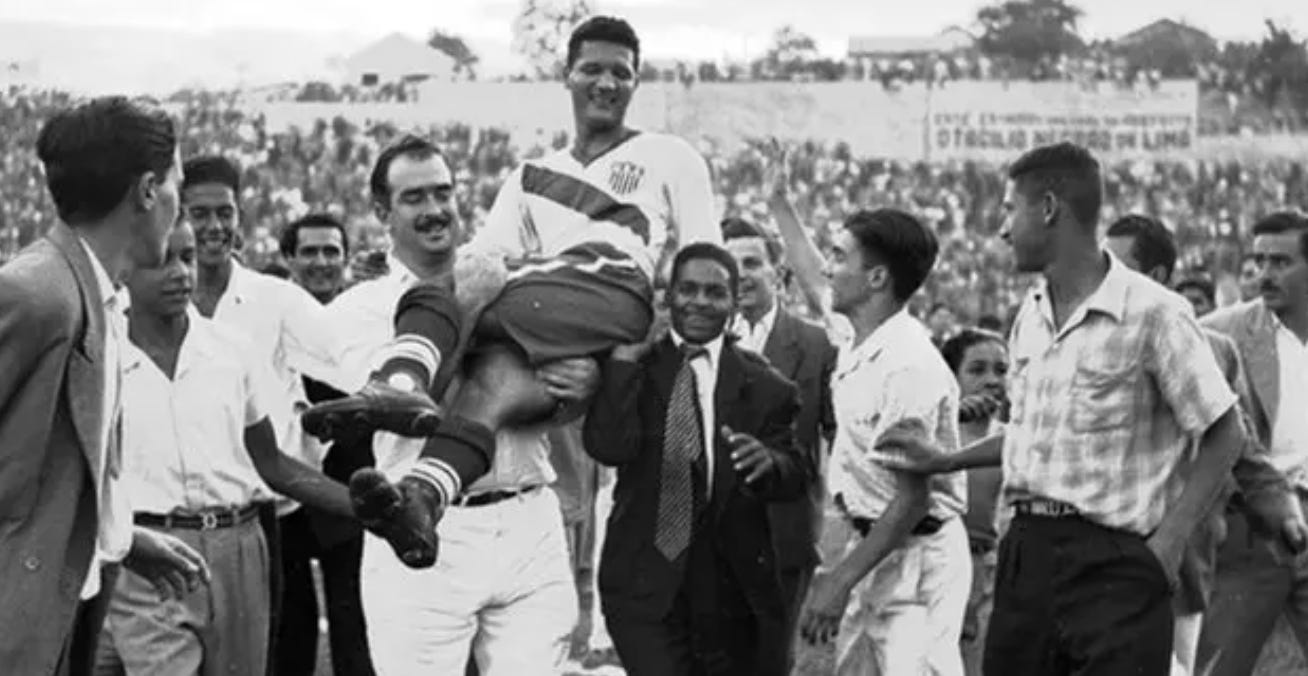
It was the summer of 1950:
Frank Borghi was driving a hearse for his uncle’s funeral home in St. Louis.
Joe Gaetjens, who had been born in Haiti, was washing dishes in New York — part of how he was paying his bills while studying on a scholarship at Columbia University.
Walter Bahr had just finished the school year teaching high school in Philadelphia; Gino Pariani was working a factory job in St. Louis.
What all four of these men had in common — along with a few others who will come into the story shortly — is that at the midpoint of the last century, they were among the best players in America in a sport that almost nobody else in America cared about: soccer.
They played in semi-professional leagues — the kind where the players held day jobs and played on weekends for modest pay. They were big fish in some very small ponds, but that was enough for them to get noticed by the United States Soccer Football Association — the governing body that ran American soccer on an annual budget of less than $50,000.
And by “noticed,” we mean “recruited to play for the American team in the 1950 World Cup.”
Quick stage-setting: This was to be the first World Cup since 1938 (because: World War II), and the entire idea of the World Cup had been kind of hanging by a trans-Atlantic string even before that.
FIFA had nearly gone broke during the war years, and when peace finally came no country wanted to host the resumed tournament, until Brazil stepped up. The Jules Rimet Trophy — the actual physical cup awarded to the winner — had spent the war years hidden in a shoebox under an Italian official’s bed to keep the Nazis from melting it down.
Anyway, the U.S. needed a team — and if there’s a joke that U.S. soccer fans hate to love about how soccer is the sport of the future in the USA, and always will be — in 1950 that would have seemed wildly optimistic.
Outside of immigrant communities and a few die-hard fans, not many people cared. And faced with fielding a national team, a selection committee picked the squad from players in the semi-professional leagues.
Their coach told reporters: “We have no chance. We’re like lambs going to the slaughter.”
One promising player couldn’t make the trip at all because his employer wouldn’t give him time off. The team trained together exactly once — the day before they left for Brazil.
Arriving for their first game, they lost handily, 3-1 to Spain.
Then, on June 29, 1950, they played England.
England was making its World Cup debut; England’s Football Association had boycotted every previous tournament, considering it beneath them. Their roster included many of the best players in the world. But against the Americans, they rested Stanley Matthews, widely considered the finest footballer alive, thinking there was no chance they’d need him.
The bookmakers had England at 3-1 to win the entire tournament. The Americans were listed at 500-1.
The Daily Mirror wrote before the match that “the only unanswered question seemed to be the size of the American’s defeat.”
The next day, however, the Associated Press reported what actually happened in the game — to a U.S. audience that was largely learning about its existence for the first time:
RIO DE JANEIRO, June 30 — If the British were to organize a baseball team and defeat the New York Yankees, it wouldn’t cause much more surprise than the United States 1-0 upset of England in the world soccer championships here yesterday.
The favored British team and the spectators were stunned by the result. The lone tally was scored by Ed Souza of Fall River, Mass. at 39 minutes of the first half.
...
Brazilian fans swarmed onto the field after the United States victory and took the North Americans on their shoulders while the victors were given an ovation.
Yep, the Americans won. However, quick correction, 76 years later: It was Gaetjens, the Haitian-born dishwasher, who scored the lone goal for the United States, not Souza.
How unexpected was the U.S. victory? In London, several newspaper editors received the wire report and printed the score as England 10, United States 1, assuming it was a misprint.
As for the American players — well, they came home and returned to their day jobs. There’s also a note of tragedy we have to add here, which is that Gaetjens returned to Haiti in 1954, married, had three children — and ten years later was killed by the secret police of dictator François Duvalier.
It was another 40 years before the United States even qualified for the World Cup again; then four years later in 1994, the U.S. hosted the tournament for the first time, setting attendance records that still stand — but will likely be broken this summer.
Major League Soccer followed, and a generation of American kids grew up playing the sport.
Still, the 1950 team is arguably the high-water mark of American men’s soccer, given that it was a group of mailmen and schoolteachers and dishwashers who beat the country that had invented the game, and had essentially no tradition of American soccer success to build on.
Fun trivia about U.S. and England soccer: England has never beaten the United States in any game that mattered in any tournament — despite soccer being England’s number 1 sport. Three meetings — 1950, 2010, and 2022 — one American win, two draws.
As this newsletter goes out, both teams are still in the 2026 World Cup, both playing their Round of 32 matches on Wednesday — the US against Bosnia and Herzegovina in Santa Clara, England against the Democratic Republic of the Congo in Atlanta.
They’re on opposite sides of the bracket. The only way they meet again is in the final, on July 19 in New York.
If it happens, say a little prayer for Joe Gaetjens and his teammates. Then tell other people who he was.
All writing is autobiographical ... so by the time you read this I’ll be on my way to my second World Cup game of this tournament. I was at France’s victory over Iraq last week in Philadelphia, and today my wife and I will watch Germany take on Paraguay near Boston.
Still rooting for the U.S.A. and Canada (and psyched after Canada’s win yesterday over South Africa). It’s a beautiful game!
7 other moments to know from history this week
June 28: “Oh Lord, won’t you buy me a Mercedes Benz.” — Janis Joplin, from the a cappella song she recorded three days before her death in October 1970, which became one of the most recognizable car references in the history of popular music. Her reference was possible only because on this day in 1926, two rival German automakers formally merged to create Daimler-Benz AG.
June 29: “The old convoy had started me thinking about good, two-lane highways, but Germany had made me see the wisdom of broader ribbons across the land.” — Dwight D. Eisenhower, from his memoir At Ease, explaining the two experiences that shaped the most consequential domestic legislation of his presidency: his experience in 1919 crossing the country in a military convoy, and watching Allied forces move rapidly across Germany on the Autobahn in 1945. On this day in 1956, he signed the Federal-Aid Highway Act authorizing $25 billion to build 41,000 miles of interstate highway, the largest public works project in American history to that point.
June 30: “Our wounds are too fresh and too painful still for us to drive them from our memory.” — Patrice Lumumba, the first Prime Minister of the independent Republic of the Congo, in an unscheduled speech he delivered at the independence ceremony on this day in 1960, directly in front of King Baudouin of Belgium. Lumumba was assassinated six months later; he was 35 years old.
July 1: “We are a great country, and shall become one of the greatest in the universe if we preserve it; we shall sink into insignificance and adversity if we suffer it to be broken.” — John A. Macdonald, Canada’s first Prime Minister, sworn in on this day in 1867. Macdonald had wanted the new country to be called the Kingdom of Canada; the British government talked him out of it.
July 2: “It ought to be solemnized with Pomp and Parade, with Shews, Games, Sports, Guns, Bells, Bonfires and Illuminations from one End of this Continent to the other from this Time forward forever more.” — John Adams, writing to his wife Abigail 250 years ago, predicting to her that July 2, 1776, the day on which the Continental Congress voted to declare independence from Great Britain, would be celebrated as America’s birthday.
July 3: “I have not had one unpleasant moment.” — Spencer Gore, the 27-year-old rackets player who won the first Wimbledon championship on this day in 1877, defeating William Marshall 6-1, 6-2, 6-4 in a final that lasted 48 minutes.
July 4: “Fans, for the past two weeks you have been reading about the bad break I got. Yet today I consider myself the luckiest man on the face of the earth.” — Lou Gehrig, speaking at Yankee Stadium on this day in 1939, two weeks after the New York Yankees first baseman had retired at 36 after being diagnosed with amyotrophic lateral sclerosis.
From the names of the players, as well as the fact that they even played soccer, much less at that level, it is clear diversity played a major role in the 1950 team. And now look at where that has brought us as a nation in just 76 years.
John “Clarkie” Souza resided in my town (York, PA) for a number of years before his passing at the age of 91 (in 2912). He was so generous - he came to my son’s soccer game and signed pictures and copies of the book “The Game of Their Lives” for the kids. Their victory was truly remarkable.